[Deep Tech] China’s Fandom Culture, the Spread of Online Violence, and Escalating Safety Risks

With a decade of experience in education journalism, Lauren Robinson leads The EduTimes with a sharp editorial eye and a passion for academic integrity. She specializes in higher education policy, admissions trends, and the evolving landscape of online learning. A firm believer in the power of data-driven reporting, she ensures that every story published is both insightful and impactful.
Input
Modified
Risks of mass online mobilization and harassment
Gendered imbalance of accountability, with a dual structure of blame and censorship concentrated on women
Educational settings require fandom literacy, rapid-response mechanisms, and safety management informed by international precedents
This article is a reconstruction tailored to the Korean market based on a contribution to the SIAI Business Review series published by the Swiss Artificial Intelligence Institute (SIAI). The series aims to present researchers’ perspectives on the latest issues in technology, economics, and policy in a manner accessible to general readers. The views expressed herein are those of the author and do not necessarily reflect the official position of SIAI or its affiliated institutions.
The primary indicator of China’s online cultural dynamics is no longer a simple follower count. As of December 2024, the number of internet users reached 1.108 billion, with 99.3% using social networks and 96.6% consuming online video content. Short-form video, in particular, has emerged as a core medium that rapidly amplifies fandom activity by fostering intense immersion and perceived intimacy within brief time spans. This environment has enabled highly organized fandom behavior and large-scale opinion mobilization, culminating in a 2025 enforcement campaign in which authorities sanctioned 76,000 fandom-related accounts and permanently shut down 3,767 of them. While presented as “communities,” these ecosystems in practice reveal an industrial structure combining rumor production with mass mobilization.
The deepfake problem is equally acute. In January 2024, pornographic composite images of a world-renowned singer circulated online, amassing tens of millions of views within hours. Threat intelligence firms warned that this case exemplified a sharp surge in the production and dissemination of malicious synthetic media. In an environment where attention translates directly into revenue, unregulated fandom culture readily devolves into collective harassment. Although patterns of victimization differ by gender, the underlying drivers lie in platform incentive structures, so-called “subsidiary account” rules, and operating models that monetize obsession.

Gender Imbalance and Structural Risk
A persistent assumption remains that fame entails tolerating rumors, malicious attacks, and even fictional romantic narratives in fan fiction. Yet the core problem lies in a market structure that incentivizes excessive attention and converts it into a weapon. While extreme fan behavior has existed in the past, today’s vast online infrastructure has scaled it into coordinated collective action.
Since 2021, Chinese authorities have sought to dismantle this structure by banning celebrity popularity rankings and restricting paid voting mechanisms targeting minors. These measures were not merely moralistic interventions but efforts to curb the hyper-intimacy competition fostered by platforms and talent agencies. The root cause lies in the fandom market and the algorithms sustaining it, yet it remains clear that women and individuals perceived as feminine are disproportionately subjected to sexually distorted attacks.
The Cost of Gendered Accountability
The imbalance of online accountability along gender lines became starkly evident in the 2025 “Xiao Incident.” A prominent surgeon, Xiao Fei, was accused—following disclosures by his wife—of multiple extramarital affairs and professional ethics violations. Allegations included claims that he intervened in disputes related to a mistress while a patient was under anesthesia.
Public attention, however, swiftly shifted toward Dong Xiying, identified as the mistress, and other women involved. Some media outlets even renamed the case the “Miss Dong Incident,” concentrating blame on female figures. According to Weibo search statistics, “Xiao Fei” appeared in trending searches 20 times before disappearing within two weeks, while “Dong Xiying” ranked 30 times and remained under scrutiny for a longer period. The women involved endured invasive exposure of their private lives and online ridicule, whereas Xiao Fei did not face comparable levels of personal disclosure or condemnation.
This case illustrates how misogynistic discourse secures expressive space even under censorship regimes and is at times leveraged as a vehicle for institutional critique, while feminist discourse faces stringent regulation and suppression. As a result, the costs of online accountability are imposed more heavily on women.
Risk Scale in Numbers
As of December 2024, China had more than 833 million live-streaming users, 1.04 billion short-form video users, and over 1.1 billion social network users. This constitutes a vast online ecosystem in which relationships are formed and reactions exchanged countless times each day.

Note: Online platforms—social networks, online video, short-form video, live streaming (X-axis), scale (Y-axis)
In a single 2025 enforcement campaign, more than 1.6 million pieces of illegal or non-compliant fandom-related content were removed, and 3,767 accounts were permanently shut down. Separate announcements reported sanctions against approximately 76,000 related accounts. Over 11,000 accounts were flagged for harmful content involving minors. In January 2024, synthetic pornographic images of Taylor Swift circulated widely, reaching 45 million views before removal. These figures indicate that tens of millions of users are exposed each year to rumor-based campaigns, with some directly participating in organized harassment.
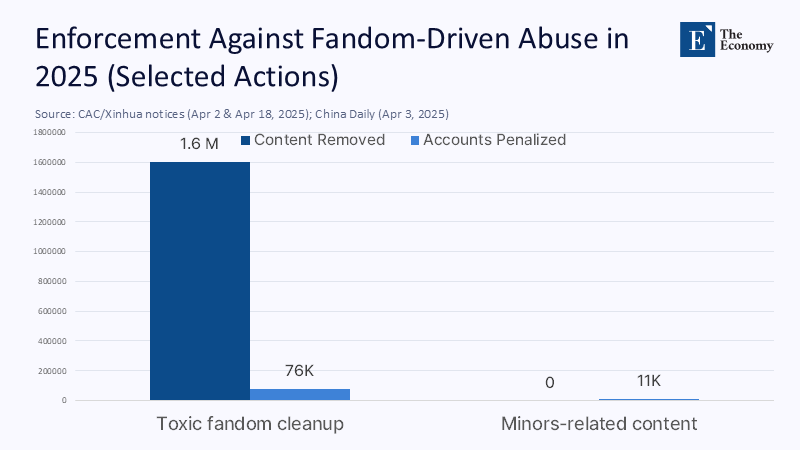
Note: Enforcement categories—harmful fandom cleanup, content involving minors (X-axis), number of actions (Y-axis) / content removal (dark blue), account sanctions (light blue)
Challenges for Educational Settings
With the expansion of online exposure through streaming lectures, influencer collaborations, student creator activities, and institutional channels, fandom culture poses a direct safety concern in educational environments. The “Regulations on the Online Protection of Minors” implemented in 2024 stipulate that schools and families bear responsibility for guiding children toward safe internet use.
Educational institutions must teach students how core fandom figures mobilize opinion, how rumors propagate, and how reputational damage unfolds. When harm occurs, reporting and blocking mechanisms must activate immediately, and response systems should account for cross-border online dissemination. South Korea’s strengthened anti-stalking legislation enacted in 2021 offers a reference point for schools operating international programs.
Reforming Policy Incentives
Reducing harm without eliminating fandom culture requires integrating existing regulations. China’s 2022 algorithm recommendation rules restrict manipulative feeds, while the 2023 deepfake labeling regulations mandate source authentication and labeling of synthetic media.
In 2025, the Cyberspace Administration of China (CAC) introduced tiered penalties calibrated to the severity of harm. Educational institutions should mirror this framework, enabling graduated responses ranging from content removal and account suspension to notification of law enforcement. Structural reforms are required, including eliminating inducements such as popularity rankings and paid voting, suppressing “outrage-driven” content, and imposing tangible identity-based costs on organized harassment.
Counterarguments and Responses
Some argue that public figures who profit from attention must accept harsh speech. Yet not all attention is of the same nature. China’s 2023 cyberviolence guidelines clarify that while strong criticism does not constitute a crime, organized humiliation, doxxing, and the creation of sexualized synthetic media can.
Concerns also persist that enforcement may chill freedom of expression. Preventive safeguards include transparent appeal procedures, independent audits of content removal, and whistleblower protections.
Another perspective frames the issue solely as gender conflict. While gender influences victimization patterns, the fundamental cause lies in the fandom market structure. Treating the problem as one of etiquette or individual resilience reduces systemic defects to matters of attitude.
Next Steps for Educational Institutions
What education systems require is neither neglect nor moral overreaction, but a design-centered approach. All official channels should incorporate risk assessment procedures and maintain systems capable of immediate response to rumor proliferation. Guidelines are also needed for scenarios in which students or staff unexpectedly attract public attention.
Administratively, institutions should collaborate with platforms to proactively detect doxxing, collective harassment, and deepfakes, embedding these safeguards into contractual terms. At the policy level, protections for minors must be integrated with algorithmic and synthetic media regulations to close loopholes that allow individual media operators to profit from harmful content.
Designing Accountability Through Structure
Online environments now directly affect the safety of educational institutions and students, a reality underscored by sheer scale: the majority of China’s population is connected to social networks. Rumors, malicious attacks, and sexualized synthetic media recur as outcomes of a mass-market economy trading in intimacy. The solution lies in structural design—reducing excessive competition for attention, enhancing transparency in algorithms and synthetic media production and distribution, and establishing rapid redress mechanisms for fast-spreading online attacks. Fame does not imply consent. Policy must be grounded in this premise.
For the original version of this research article, please refer to When Fame Becomes a Terms-of-Service: Why Schools Should Treat Fan Economies as a Safety Risk, Not a Sideshow. Copyright of this article belongs to the Swiss Artificial Intelligence Institute (SIAI).
With a decade of experience in education journalism, Lauren Robinson leads The EduTimes with a sharp editorial eye and a passion for academic integrity. She specializes in higher education policy, admissions trends, and the evolving landscape of online learning. A firm believer in the power of data-driven reporting, she ensures that every story published is both insightful and impactful.
Similar Post