Trump Eases Rhetoric on International Students as Universities Flag Financial Stress and Economic Spillovers

With a decade of experience in education journalism, Lauren Robinson leads The EduTimes with a sharp editorial eye and a passion for academic integrity. She specializes in higher education policy, admissions trends, and the evolving landscape of online learning. A firm believer in the power of data-driven reporting, she ensures that every story published is both insightful and impactful.
Input
Modified
The administration signals a partial retreat from its earlier hardline posture on international students
Demand for U.S. study weakens following Trump’s second term, dampening enrollment momentum
Universities warn of intensifying financial strain amid softer domestic demand and budget pressures

Donald Trump, who had pressured U.S. universities to limit enrollment of international students, has abruptly reversed course. He now calls foreign students “a good practice” for the country and suggests that hosting them is essentially “a business.” The shift reflects growing concern over the financial strain on universities and the broader economic impact caused by the sharp decline in international enrollment.
Trump: “Taking in International Students Is a Business”
In an interview with Fox News host Laura Ingraham on the 10th, President Donald Trump said he does not want to “reduce the number of students coming to the United States from around the world,” adding that he has no intention of “destroying the entire university system.” When pressed on why he is not cutting back on foreign students — particularly those from China — Trump responded that limiting enrollment would create financial damage and could even force some institutions, including historically Black colleges, to shut down. He also stressed that the U.S. “earns trillions of dollars from students” and that international students “pay more than double in tuition.” He added, “It’s not what I want, but in practice, taking in students functions as a business.”
Trump’s comments mark a sharp departure from the policies his second administration has pursued against international students. Earlier in May, the administration took the unusual step of stripping Harvard University of its ability to recruit foreign students after the school refused policy changes tied to combating antisemitism. The government also moved to reduce foreign enrollment through measures such as canceling visas for Chinese students, arresting pro-Palestinian student activists, and tightening application requirements.
Last month, the administration proposed a “Higher Education Academic Excellence Agreement” to nine U.S. universities, calling for the elimination of diversity, equity, and inclusion (DEI) policies. The proposal included conditions such as banning the consideration of gender, race, nationality, political views, or sexual orientation in admissions; capping foreign-visa students at 15% of total enrollment; and limiting students from any single country to no more than 5%.
Sharp Decline in Students Heading to the United States
Trump’s abrupt reversal comes against the backdrop of mounting financial strain across U.S. universities. Since the start of his second administration, applications from international students have dropped sharply. A survey by the Institute of International Education (IIE) covering more than 500 U.S. colleges and universities showed that international applications for the spring term fell by 35 percent — the steepest decline since the COVID-19 pandemic.
The trend continued into the second half of the year. According to the International Trade Administration (ITA), 313,000 foreign students entered the United States in August, down 19 percent from a year earlier and the lowest level since 2021. The decline was driven largely by Asian students, who make up the biggest share of America’s international student population. Only 191,000 students from Asia arrived in August, a drop of 24 percent. All 13 major Asian source countries — including Korea and Japan — recorded declines. India saw the sharpest fall at 45 percent, while China declined 12 percent.
The downturn is not limited to undergraduate programs. Interest in U.S. graduate studies has also plummeted since Trump took office. Studyportals, a Netherlands-based global education platform, reported in April that demand for U.S. MA and PhD programs in the first quarter of 2025 fell 44 percent after mid-January, with an additional 3 percent drop after March 18. The company noted that U.S. graduate schools, once seen as symbols of advanced research and academic freedom, have lost significant trust among international students due to recent cuts to federal research funding and political attacks on university administrations. As a result, the U.S. share of the global study-abroad market fell 21 percent in the first quarter of 2025.
Campus and Domestic Economy Face Growing Strain
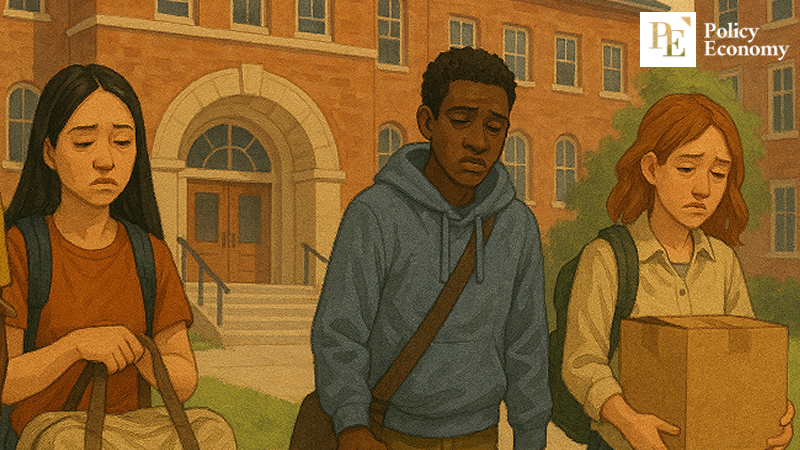
The drop in international enrollment is dealing a direct blow to university finances, as fewer foreign students inevitably mean lower tuition revenue — a core funding source for many institutions. The University of Southern California recently said the sharp decline in Asian students was a major factor behind a USD 200 million deficit. Arizona State University’s president also remarked that visa delays have been “more damaging than the pandemic.”
Shrinking demand for U.S. study programs could also spill over into the broader economy. International students are a critical pillar of domestic consumption. According to a report by NAFSA last year, 1,126,690 foreign students were enrolled in U.S. institutions on F and M visas during the 2023–2024 academic year, accounting for 5.9 percent of all students nationwide.
NAFSA estimated that these students generated about USD 43 billion in annual economic benefits in the form of tuition, housing, and living expenses. Their spending supported 378,175 U.S. jobs. In April, The Washington Post noted that the United States “sold more educational services abroad last year than the combined value of natural gas and coal,” emphasizing the country’s significant trade surplus in the sector.
With a decade of experience in education journalism, Lauren Robinson leads The EduTimes with a sharp editorial eye and a passion for academic integrity. She specializes in higher education policy, admissions trends, and the evolving landscape of online learning. A firm believer in the power of data-driven reporting, she ensures that every story published is both insightful and impactful.
- Previous [Diagnosing the Breakdown of Universities] Palantir’s “Post-University” experiment poses a stark question: in the age of AI, what is higher education actually for?
- Next Public Care Expansion and Gender Equality Policies Reshape South Korea’s Labor Market, Working Mothers’ Employment Rate Hits Record 64.3%
Similar Post