Australian Student Visa Fees Are Pricing Out Skilled Talent

Input
Modified
Australia raised student visa fees while persistent skills shortages remain unresolved
Chinese demand is weakening, but India is not replacing the lost pipeline
Migration policy should reward skilled pathways instead of relying on higher fees

Australia now charges A$2,500 (US$1,767) for a standard student visa. Two years ago, the same base charge was A$710 (US$502). That rise is more than a fee update. It changes the price of entry into one of the country’s main talent pipelines. Australian student visa fees have climbed while overseas student numbers are under pressure, Chinese demand is cooling and employers still report hard-to-fill skilled roles. The policy signals point in opposite directions. Australia wants tighter control of migration and stronger public trust in the system. It also wants skilled workers, fee-paying students, research talent and graduates who can fill gaps in health, teaching, engineering, technology and the trades. Charging much more at the front door may raise revenue and deter weak applications. It may also turn away people the skilled system later hopes to keep. That trade-off now matters more than the headline migration number. The better question asks how well the migration system can sort future skills from low-value churn, rather than how many student visas it can price out. Study is often the first stage of a longer route into work. Some graduates leave, as expected. Some remain in jobs below their training. Others move into skilled work and later qualify for permanent residence. A sound system should tell those groups apart as early as possible. It should charge fees that reflect real processing costs, test whether the applicant and course are credible and give strong graduates a clearer path into areas of need. The current mix falls short on that last point. It raises a broad price on entry while Australia still has a narrow route into permanent skilled work and many jobs that firms struggle to fill.
The Visa Fee Is Becoming a Talent Tax
The scale of the rise matters. The student visa base charge moved from about US$502 to US$1,131 in July 2024, to US$1,414 in July 2025, and then to US$1,767 in July 2026. In two years, it rose by about 252 percent. The latest change also affected other visas. The Temporary Graduate charge rose from about US$3,251 to US$4,064. Several major skilled visas now cost slightly more than US$4,311 for the main applicant. Partner and working holiday charges rose as well. Australia is using visa fees as a stronger price gate across the migration system. That may help fund processing and cut weak demand. Yet it also puts more of the cost and risk on applicants before Australia knows what skills they may bring. For a country short of some key workers, the fee is a blunt way to screen talent.
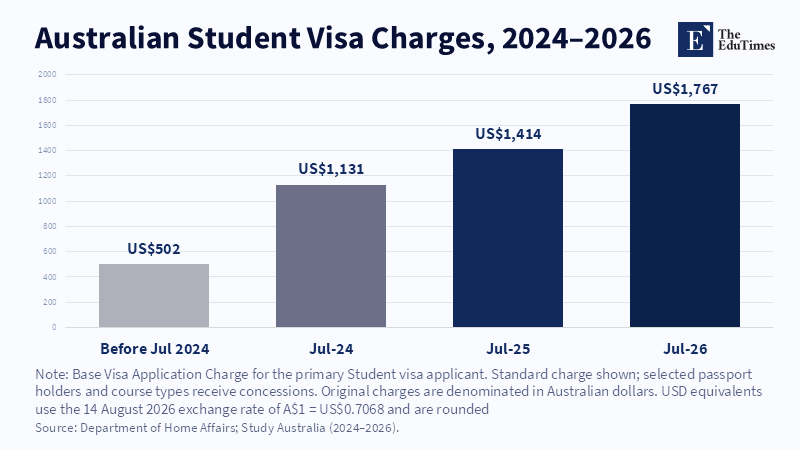
Price can filter demand, but it cannot test nursing skills, English ability, work history, course quality, or the chance that a student will finish a degree. It mainly tests the ability and willingness to pay. That matters when students already face tuition, rent, insurance, travel and proof-of-funds rules. The additional US$1,265 added to the base fee since mid-2024 arrives before a visa is granted and while the result remains uncertain. Australia also competes with other study markets. A high upfront charge can change the choice of students who have several good offers. Australian student visa fees may therefore screen out some strong candidates for the wrong reason. A better price test would be tied to risk, course quality and labor need rather than applied as one large hurdle to almost everyone.
Australia’s Student Market Is Narrowing
The timing is poor. In the first five months of 2026, Australia hosted about 680,600 international students, down 6.9 percent from the same period a year earlier. Enrolments fell 8 percent and new student numbers fell 6 percent. Higher education was more resilient, with enrolments still up 2 percent, while English-language study dropped much more sharply. The broad market is softer than the post-pandemic surge. The fall is far from a collapse. Still, demand can no longer be treated as automatic. Fee policy matters more when students have more choices and application growth is weaker. A country can raise prices with less risk when demand is racing ahead. The same move becomes harder to defend when parts of the market are already shrinking.
China remains Australia’s largest student source, with India still in second place rather than acting as a full replacement. In May 2026, Chinese students made up about 23 percent of the international student population and Indian students about 16 percent. That was roughly 137,300 students from China and 98,000 from India. Yet the concern behind the China story is real. Offshore higher education visa applications from China fell 26 percent in the 2025–26 financial year. India also weakened, so it did not fill the whole gap. Faster growth came from markets such as Nepal and Bangladesh, while visa grant rates for some South Asian applicants were low. Australia is becoming more exposed to shifts across several Asian markets at once. Raising Australian student visa fees into that uncertainty adds another reason for good applicants to look elsewhere.
Chinese students also have more reasons to study at home. China reported 48.46 million students in higher education in 2024 and a gross higher education enrolment rate of 60.8 percent. Its domestic system has grown in scale and choice for years. Overseas demand will remain, although the choice now looks different. Australia is no longer competing only with the United States, Britain, Canada, or other study destinations. Australia also competes with stronger home options. Cost therefore carries more weight. The stakes for Australia are large: International education produced about US$38.9 billion in export income in 2025, with higher education accounting for more than US$28.3 billion.. A market of that size should not be treated as a tap that can be tightened for revenue and reopened later with no lasting effect on demand.
Australian Student Visa Fees Miss the Skills Problem
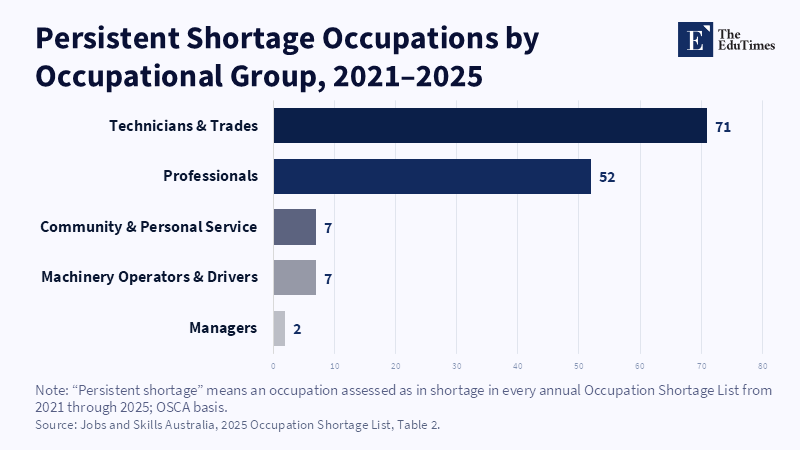
Australia’s deeper migration problem is the match between people and jobs. Jobs and Skills Australia found 293 occupations in national shortage in 2025, or 29 percent of the occupations it assessed. The share has fallen since 2023, which is welcome. Yet 139 occupations were in shortage every year from 2021 to 2025. Professional roles and trades made up a large part of those long-running gaps. Health, teaching, construction and technical work remain difficult areas. The agency’s shortage work also shows that a lack of people with the right training or experience is a common cause. Those are skill gaps. A broad rise in Australian student visa fees does little to fix them. It can reduce demand at the border, but it cannot make the pool of future workers better matched to the jobs Australia needs filled.
The permanent program has its own design problem. Australia plans 185,000 permanent migration places for 2026–27, with about 132,240 in the skilled stream. That sounds heavily focused on skills. Yet the label can hide how many places actually add a new skilled worker from overseas. Research by Peter McDonald and Alan Gamlen found that only about 12 percent of places in the permanent program went to offshore skilled entrants under the structure they examined. Partners, children and family places take a large share of the total. Their work also points to strong labor outcomes for employer-sponsored migrants. Family migration carries its own social value. The problem here is clarity. A program sold as a skills tool should be judged by how much skill it adds and how well it links proven workers to permanent status.
International students fit awkwardly into this design. They are often discussed as a short-term population pressure, yet they also form a large pool of people who can be tested in Australia before any permanent visa is offered. Their study results are known. Their English can be seen in practice. Their work record can be checked. Employers can judge whether their skills fit the job. McDonald and Gamlen argue that students and other temporary migrants already feed skilled employment. Former Home Affairs Minister Clare O’Neil also warned in 2023 that many international graduates were working below their skill level while shortages remained. The result is lost capacity. The answer is a tighter bridge from good study to good work. A high entry fee for every student, regardless of field or future value, does not create that bridge.
There is a fair case against cheaper student visas across the board. Lower fees could draw more weak applications, add pressure to housing and encourage cases where study is mainly used as a route to work. Those risks are real. They are also reasons to improve selection. Australia can demand strong proof of funds, enforce course standards, close poor providers, test genuine study intent and reject applicants who do not meet the rules. It can tighten repeat temporary visas when there is no clear study or work progress. None of this requires a very high fee for a strong applicant in a field of need. Price and quality are different policy tools. Using price as a stand-in for quality may block applicants with less cash while doing little to stop weak but wealthier candidates.
Price for Skills, Screen for Quality
A better model would link student entry, graduate work and permanent skilled migration more closely. Australia already has data on courses, providers, visa status, graduate work and occupation shortages. That makes a more targeted fee system possible. Students entering high-quality courses tied to clear shortages could face a lower visa charge. Nursing, teaching, engineering, digital roles and selected trades may qualify when the evidence supports it. The list should change as shortages change. Providers with weak completion or work outcomes should lose access to the lower rate. Existing concessions for some countries and course types already show that one price is not the only option. A targeted discount would not buy anyone permanent residence. It would simply lower the first cost for people training in fields where Australia has a clear reason to attract more talent.
The other side of reform should be stricter. Low-quality providers need stronger checks. Visa cycling should become harder when a person shows no real study or work progress. Temporary work routes should have clear rules on pay, duration, employer need and repeat use. At the same time, strong graduates who move into shortage jobs should receive a simpler and more stable path. Universities and colleges should also show more than enrolment growth. Completion, graduate work, field-of-study match, English gain and employer demand should matter when policy settings are reviewed. This creates a better bargain. Providers gain a case for lower Australian student visa fees in courses that meet real needs. Government gets a stronger quality test. Students get clearer signals about which study paths have value beyond the campus. The system starts to reward evidence of skill rather than the ability to absorb repeated charges.
The roughly US$1,767 student visa fee is a useful test of what Australia wants migration policy to achieve.. If the main goals are lower demand and more fee revenue, the current path is easy to read. If the goal is a stronger skills base, the price signal sits in the wrong place. Australia has raised the base student visa charge by more than 250 percent in two years while long-running skill gaps remain and key student markets soften. The next reform should be more precise. Lower Australian student visa fees for credible study routes tied to real shortages. Keep strict checks on course quality and genuine study. Make weak migration pathways harder to cycle through. Give proven graduates in shortage fields a clearer skilled route. Australia does not need the cheapest visa system. It needs a system whose prices and rules match the workers the country says it needs.
This article reflects the analytical judgment of The EduTimes Editorial Board and does not constitute policy advice or the official position of any affiliated institution.
References
Clare, J., O’Connor, B., O’Neil, C. and Giles, A. (2024) ‘Fee increase for international students part of July 1 migration reforms’, Ministers’ Media Centre, 1 July.
Department of Education (2026a) Education Export Income – Calendar Year 2025. Canberra: Australian Government.
Department of Education (2026b) International Student Monthly Summary: Year-to-Date May 2026. Canberra: Australian Government.
Department of Home Affairs (2026) Permanent Migration Program Planning Levels: 2026–27. Canberra: Australian Government.
Edwards, A. (2026) ‘Immigration crackdown delayed as expert reveals the “real issue” facing Australia’s migration system’, 7NEWS, 6 August.
Gamlen, A. and McDonald, P. (2025) ‘The problems with Australia’s Permanent Migration Program and how to address them’, ANU Policy Brief, 9 September.
Jobs and Skills Australia (2025) 2025 Occupation Shortage List: Key Findings Report. Canberra: Australian Government.
McDonald, P. and Gamlen, A. (2025) Reforming Australia’s Permanent Migration Program: Enhancing the Links between Temporary and Permanent Migration. ANU Migration Hub Insights 25/1. Canberra: The Australian National University.
Ministry of Education of the People’s Republic of China (2025) 2024 National Statistical Bulletin on Education Development. Beijing: Ministry of Education, 11 June.
O’Neil, C. (2023) ‘How Australia broke its migration system, and what we can do to fix it’, Minister for Home Affairs, 22 February.
RACC Australia (2026) ‘Australia Visa Fee Increase From 1 July 2026: Complete Guide’, 30 June, updated 3 July.
Ross, J. (2026) ‘Application numbers slump as Australia rejects third of student visa bids’, Times Higher Education, 31 July, updated 4 August.
Study Australia (2025) ‘Student Visa Application Charge increase’, 2 July.
Study Australia (2026) ‘Student Visa Application Charge increase’, 3 July.
University World News (2026) ‘Tripling of visa charge could deter international students’, University World News, July.