Why Companies Are Failing to Hire PhD Talent

Input
Modified
More new PhDs enter industry than academia, but employer screening is narrowing
Recruiters often see university pedigree before the research behind a doctorate
Closing the gap requires better corporate roles, evaluation methods and career paths

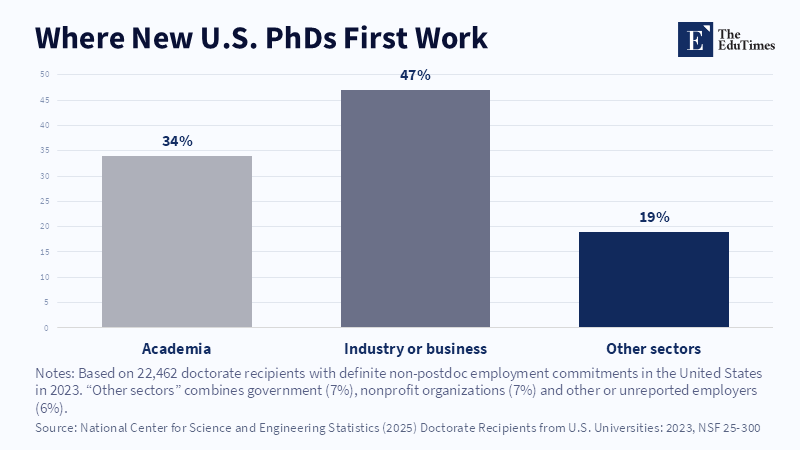
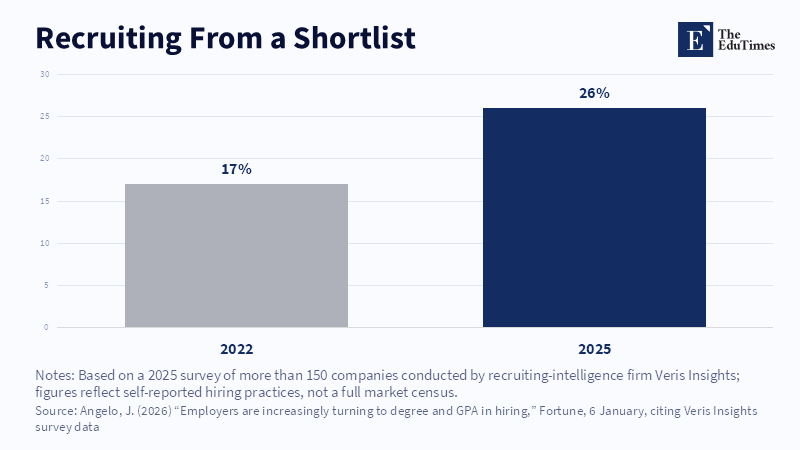
Something close to half of every freshly minted doctorate holder in the United States who has a job lined up at graduation walks straight past the university gate. In 2023, 47 percent of doctorate recipients with a definite job commitment took it in industry or business. Only 34 percent went into academia. That gap has been widening for years and it should have reshaped how doctoral programs think about their job. It hasn't, not really. Faculty still measure success by how many students land a professorship, a postdoc or a slot at a research institute, the jobs professors themselves once wanted. The employers now absorbing most new PhDs are narrowing, not widening, how they hire. A 2025 survey found that more than a quarter of large companies now recruit from a short list of elite schools, up from 17 percent three years earlier. The people best placed to close that gap are the employers, not career offices.
Graduate Schools Are Measuring Success by the Wrong Standard
Doctoral training, especially in research-intensive universities, was built around a single measure of success: did the student become a researcher. Faculty advisers, department rankings and even funding formulas still lean on that yardstick, even though the maths stopped working a while ago. Doctoral graduates now vastly outnumber academic openings and this mismatch shows no sign of correcting itself, since PhD production keeps climbing while tenure-line hiring stays roughly flat. Programs have started adding workshops on networking and resume writing for students who won't stay in academia. That's a start but it treats the symptom. The underlying assumption, that a "good" outcome is another research post, hasn't moved.
Between 2023 and 2024, the share of doctorate recipients with a definite job commitment fell across nearly every science and engineering field, while the share taking on another postdoc rose in most of them. Read plainly, that means more graduates are choosing or being pushed into a second temporary academic stint rather than a first real job. This isn't laziness or misplaced ambition so much as the rational response of someone trained inside a system that rewards one kind of achievement and barely recognizes any other. The habit runs deep. A large study of hiring across all PhD-granting American universities found that a small minority of institutions, about a fifth of them, supply four out of every five faculty positions in the country. Academic hiring is already an insular, brand-driven exercise long before a graduate ever applies for a job outside it. Departments that operate this way at home are unlikely to build strong bridges to industry, because their own reward system doesn't ask them to.
Employers Are Screening the Diploma, Not the Dissertation
Here is where the story usually gets told wrong. Most accounts of the PhD job problem treat it as a supply-side failure: universities aren't preparing students well enough, students don't know how to sell themselves, career services are underfunded. All of that may be true in parts. But look at what employers are actually doing and a different picture appears. A 2025 survey of more than 150 companies found that 26 percent were recruiting from a narrow shortlist of universities, up sharply from 17 percent in 2022. Firms that once prided themselves on hiring broadly are pulling back. One recruiting firm quoted in the coverage put it bluntly: employers are leaning harder on degree and institutional pedigree because it lets them screen faster and cheaper. Even McKinsey, a firm that used to advertise that it hires people rather than degrees, has quietly dropped that language and now runs high-touch recruiting events at a shortlist of twenty schools.
That filter has a specific effect on PhDs. A recruiter with three hundred applications to sort through cannot read three hundred dissertations. So they don't try. They look at the institution's name, sometimes the department, rarely the actual research. A candidate who spent five years building a genuinely novel method in materials science or labor economics gets sorted by the same rough heuristic as someone applying straight out of an undergraduate program. The depth of the work, the very thing a doctorate is supposed to certify, becomes almost invisible at the point of hire. This is less a failure of the candidate's communication skills than a screening process built for volume, not depth, applied to a credential that is entirely about depth.
Why More Career Coaching Will Not Fix the Hiring Gap
The standard fix proposed in higher-education circles is to improve non-academic career guidance: better mentoring, clearer information about industry paths, more contact between departments and employers. These efforts help individual students find their footing and nobody should stop running them. But they are aimed at the wrong side of the transaction. Coaching a graduate to write a punchier resume does nothing to change a recruiting model that filters by university brand before anyone reads a resume at all. The problem sits upstream of the applicant.
There's also a version of this argument that blames PhD training itself, insisting graduates need to align their research more closely with "societal needs" so that industry sees the value more easily. The evidence doesn't support that framing either. Where doctorate holders do land industry roles, the outcomes are strong: among postdocs surveyed by a major science publication, those working in industry were rare, only about 7 percent of respondents, yet nearly a quarter of them earned between $80,000 and $110,000 a year, compared with just 5 percent of their academic counterparts at that pay level. Industry doesn't dislike what PhDs offer once they're in the door; very few get through the door in the first place and the ones who do are often filtered in by luck, personal networks or a lucky match with a recognizable university name rather than by any structured process built to identify research talent.
Skeptics will point out that some companies genuinely can't use PhD-level specialization and that pushing every graduate toward industry ignores real differences in what jobs require. That's fair as far as it goes. Not every corporate role needs five years of dissertation-level depth and forcing a mismatch helps no one. But the criticism proves the point rather than undercutting it: if roles genuinely don't require that depth, companies should be honest about hiring for breadth instead, rather than filtering on a doctoral credential's brand value while ignoring the substance behind it. Using the name recognition of a degree as a shortcut, without building any capacity to evaluate or apply the expertise it represents, wastes the signal on both sides.
The Solution Has to Start Inside Companies
If the bottleneck sits with employers, then the solution has to as well. Companies that want to make real use of doctoral-level talent need structures built for it: rotational research and development programs that let a new hire apply deep expertise from day one rather than starting over in an entry-level generalist track, technical career ladders that let someone rise without becoming a people manager and in-house scientific advisory roles that treat specialized knowledge as a permanent asset rather than a one-off project. Some large technology and pharmaceutical firms already run programs like this and they tend to retain doctoral hires longer and promote them faster than firms that simply drop PhDs into standard graduate schemes built for twenty-two-year-olds. That's not a coincidence. It reflects deliberate investment in absorption capacity, not just recruiting spend.
This is a demand-side investment question more than a training one and it deserves to be treated as such by policymakers as much as by employers. Government incentives for industry-academia placements, tax treatment for structured research fellowships inside firms and public reporting on how companies actually use doctoral hires once hired, not just how many they recruit, would do more to close this gap than another round of career-readiness workshops on campus. Universities can keep polishing how they prepare graduates for the world of work. That work matters but it was never going to be enough on its own, because the constraint was never really about preparation.
Nearly half of new PhDs already head into industry the moment they graduate and the share doing so keeps growing. What's shrinking is the number of employers willing to look past a shortlist of familiar university names to find them. Closing the PhD hiring gap will not come from another workshop on how to translate a dissertation into a resume bullet point. It will come from companies building the internal roles, evaluation methods and career ladders needed to actually use the research talent already knocking on the door. Until that investment happens, the mismatch between trained researchers and the jobs that need them will keep being described as an education problem, when it has been a corporate one all along.
This article reflects the analytical judgment of The EduTimes Editorial Board and does not constitute policy advice or the official position of any affiliated institution.
References
Angelo, J. (2026) ''Employers are increasingly turning to degree and GPA' in hiring: Recruiters retreat from 'talent is everywhere,' double down on top colleges', Fortune, 6 January.
Kwon, D. (2025) 'How many PhDs does the world need? Doctoral graduates vastly outnumber jobs in academia', Nature, 22 June.
National Center for Science and Engineering Statistics (2025) Doctorate Recipients from U.S. Universities: 2023, NSF 25-300. Alexandria, VA: National Science Foundation.
National Center for Science and Engineering Statistics (2026) Doctorate Recipients from U.S. Universities: 2024, NSF 26-315. Alexandria, VA: National Science Foundation.
Nordling, L. (2023) 'Postdoc career optimism rebounds after COVID in global Nature survey', Nature, 622(7982), pp. 419–422.
Wapman, K.H., Zhang, S., Clauset, A. and Larremore, D.B. (2022) 'Quantifying hierarchy and dynamics in US faculty hiring and retention', Nature, 610(7930), pp. 120–127.
Woolston, C. (2024) 'How to find your place in science through an industry postdoc', Nature, 19 December.