Critical Thinking in Education: Assessment Must Reward Judgment

Input
Modified
Assessment should reward judgment, verification and revision
AI makes visible reasoning more important for education
Critical thinking grows through repeated defended decisions

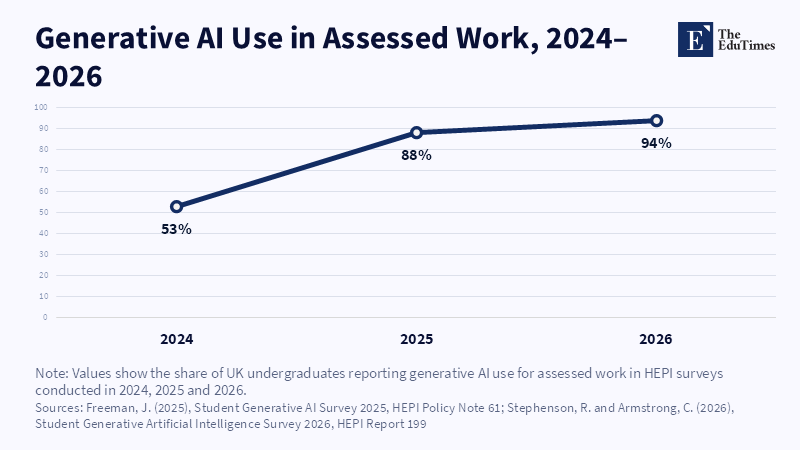
In the UK, 94 percent of undergraduate students now say they use generative AI for assessed assignments. The figure comes from a 2026 survey of 1,054 full-time students. Education cannot be based on the assumption that homework delivered is a pure sample of individual thinking. Nor is it enough to ask students to use technology responsibly. When the system primarily grades the final text, a strong incentive is created to assign to a tool as much of the work as possible. Critical thinking in education needs a different approach. The path to an answer must be made visible, checked and graded. The value of work must lie in interpreting, questioning, verifying and defending a judgment. That is where AI ceases to function as an easy replacement and begins to become a learning tool.
Critical Thinking in Education Must Be Visible in Assessment
Copying was not born with generative artificial intelligence. Students copied from books, from older students, from ready-made assignments and later from the internet. The difference today is the speed, quality and availability of the substitute. A tool can produce in seconds a clear, convincing and often adequate answer. If the score is only about this answer, the educational system rewards effective text production more than the intellectual work it is supposed to measure. Critical thinking in education must therefore move from the abstract goal to the object of evaluation. The investigation of who pressed which key offers little pedagogical value. It needs to be seen who understood the problem, who distinguished a strong argument from a weak one, who detected uncertainty and who changed position when the evidence demanded it. These actions can be observed. They can also be scored much more accurately than a general impression that a text looks mature.
The academic literature provides a useful context. A large 2023 review describes six measurable skills that make up critical thinking: interpreting information, analyzing arguments, drawing conclusions, assessing credibility, clear explanation of reasoning and self-regulation. The same paper divides critical thinking into three broader fields. The first is about judging the outside world. The second is about checking personal assumptions and biases. The third is about turning judgment into decision and action. This classification offers something more useful than a general requirement for deeper thinking. It allows the teacher to design specific work. The student may be asked to interpret an obscure source, compare two conflicting explanations, identify which conclusion is not sufficiently supported and explain what evidence would make them change their mind. Thus, critical thinking in education acquires content that is visible to both the student and the evaluator.
The need becomes more pronounced when cognitive unloading is considered. A 2025 study of 666 adults found a negative association between frequent use of AI tools and performance on critical thinking tests, with cognitive unloading acting as an important intermediate factor. The finding is correlational and does not prove that AI causes a loss of competence on its own. Nevertheless, it is consistent with a mechanism that education policy should take seriously. The easier it becomes to delegate judgment to an external tool, the more tasks are needed that require the student to regain that judgment. A small MIT study in 2025 moved in the same direction. Among 54 participants who wrote essays, the group using a large language model showed the weakest neural connectivity measured by EEG. The sample was small and the study remains a preprint. The result therefore needs caution, but convenience still requires a pedagogical counterweight.
Build Critical Thinking Into Everyday Coursework
The answer does not have to be a new stand-alone lesson called critical thinking. The most powerful solution is to change the cognitive requirement within existing courses. A 2024 randomized study of 2,011 eighth-graders and 21 teachers tested exactly this idea. Critical thinking was incorporated into English lessons once a week for three months. Students showed a small positive improvement in critical thinking skills, while no corresponding improvement in usual academic performance was recorded. The result matters for policymaking. An education system can state that it wants better judgment and at the same time continue to reward mainly recall, speed and correct form. Students will then direct their effort to where the grades are. Critical thinking in education needs to appear in exams, assignments and evaluation criteria. Otherwise, it remains a good intention in the curriculum.
Methods that require students to solve problems and defend choices already have a stronger foundation than simple text generation. A 2023 meta-analysis of 36 empirical studies found an overall effect of 0.82 for collaborative problem-solving on critical thinking. The effect on cognitive skills was smaller, but remained substantial, at 0.70. A 2024 study also combined a 57-student randomized trial with a meta-analysis of eight earlier trials involving 1,819 pharmacy students. Problem-based learning was associated with better critical thinking, although heterogeneity between studies was high. This last point matters. There is no one activity that works everywhere. The outcome depends on how it is applied, the subject matter, the guidance and the time. The direction is still clear. Critical thinking develops when the student has to compare alternatives, manage uncertainty, discuss with others and justify a choice that can be challenged.
This also changes the role of the teacher. A good question does not simply ask for more words. It asks for a trail of decisions. A history paper might give three sources that disagree and ask the student to decide which explanation they consider stronger, which evidence they reject and which new evidence could overturn their judgment. In science, students may be asked to choose between two models with imperfect data. In administration, a student may be asked to choose a policy with real cost, time and risk constraints. The final product still matters, but the score is now split between the answer and how it was built. Critical thinking in education thus becomes a daily practice. Students learn that a good answer is not judged only by how smoothly it reads. It is judged by whether it holds up when evidence is requested.
Make AI an Object of Verification
The most useful educational use of AI may be one that increases the demand for judgment rather than decreasing it. A 2025 study of sixth-graders examined generative AI as both a cognitive tool and a critical analysis tool. Of the 163 students who initially participated, 126 completed all measurements. The two AI-supported groups showed better knowledge transfer than the traditional teaching group, while critical thinking was significantly related to depth of learning. The crucial element lies in the design of use. The tool can produce material, but the student must examine it, correct it and integrate it into their own reasoning. When AI becomes a source that needs control, it creates opportunities for interpretation, analysis, evaluation and self-regulation. These are precisely the skills that critical thinking in education should enhance.
A practical form of this design is working with a transparent history of use. The student can use artificial intelligence but is required to keep the important questions asked, the answers used, the points rejected and the sources used to verify basic claims. This requirement does not have to turn into bureaucracy. A short record of decisions is enough to reveal whether the student treated the tool as an authority or an imperfect partner. The system can also be asked to produce a deliberately problematic answer and the student's ability to identify errors, unsupported conclusions and biases can be scored. The same task can close with a brief oral defense. Artificial intelligence remains in the process, but critical thinking cannot be surrendered with it. The student must show an understanding of what was chosen and why.
The two-lane approach implemented at the University of Sydney offers a useful basis for this logic. One part of the assessment is completed in a controlled environment so that the institution can confirm basic knowledge and skills without uncontrolled outside help. The other part remains open and is designed with the assumption that students will have access to artificial intelligence. There, the use of technology is supported and assessed as part of learning. This distinction avoids two extreme options. It does not require that all exams be converted into supervised tests and it does not treat every homework assignment as reliable proof of individual competence. Critical thinking in education can be placed between these two directions. Some skills must be demonstrated without help. Others must be proven in an environment where help exists and the student is judged by how well it is managed.
Redesign Assessment Around Evidence of Thinking
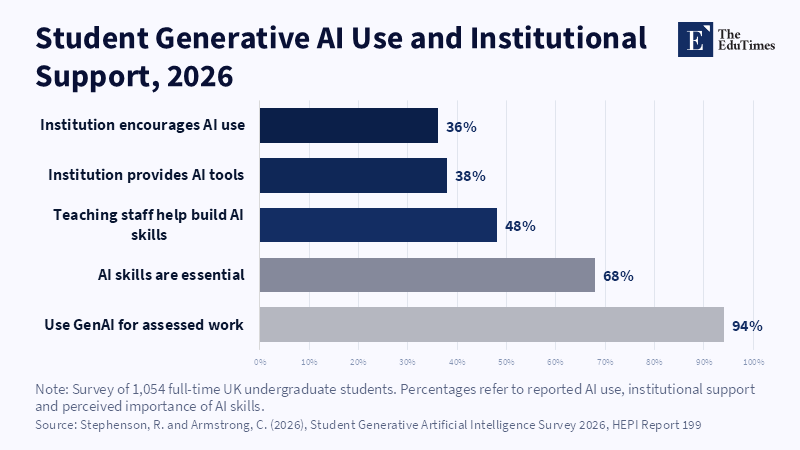
The biggest difficulty lies beyond devising smart exercises. It concerns motivation across the curriculum. The 2026 HEPI survey shows the gap. While 94 percent of students use generative AI in assessed work, only 36 percent say their institution encourages them to use it and only 38 percent report being provided with relevant tools. Use has therefore become almost universal before common pedagogical practice has been established. The result is uneven guidance. One student learns to check sources and state the use of the tool. Another simply learns how to produce more persuasive text. A third may not have access to the same level of tools. Critical thinking in education therefore needs program-level rules, not piecemeal choices by individual instructors. Common language is needed on what good use means, which stages are evaluated and which skills need to be demonstrated without outside help.
The cost objection is serious. Oral defenses, process checks and more complex assignments take time. Returning to an essay that can be produced almost entirely by one tool does not solve the problem. Evaluation needs to be redistributed. Fewer assignments can have more weight and a clearer purpose. Short oral questions can be used at selected points instead of long exams in every course. Process checks can be completed through small intermediate deliverables, without constant monitoring. Above all, the rubrics need to change. If most of the score continues to depend on the final text, student behavior will hardly change. Evaluation must place substantial value on the quality of sources, verification, the ability to revise, the explanation of a decision and the recognition of uncertainty. This is where the real reform lies.
There is also a broader reason for this change. In the Future of Jobs 2025 survey, 69 percent of surveyed employers identified analytical thinking as a core skill for their workforce. The survey covered more than 1,000 employers representing over 14 million workers in 55 economies. The distance between this requirement and training that primarily rewards smooth text production is becoming increasingly difficult to justify. Generative AI makes this weakness visible because it produces exactly the product that for years has been used as a rough substitute for thinking. Critical thinking in education must now move from proclamation to structure. Every program needs clear points where the student interprets, disputes, verifies, decides and defends. If these actions count in the grade, they will be practiced. If they are left out of the evaluation, the easier route will continue to win.
The 94 percent figure shows much more than the speed of adoption of a new technology. It shows that the old relationship between work and proof of learning has already changed. The next educational reform needs to start from this reality. Teachers need to plan tasks that require judgment at every key stage. Administrations need to provide time, training and common rubrics. Policymakers need to ask curricula for evidence that critical thinking is taught and evaluated as a real skill. AI will continue to become faster and more persuasive. Education's response cannot be based on the hope that students will choose the hardest path for themselves. The system must make thinking part of the path to a grade. Critical thinking in education can then become a habit that technology finds difficult to replace.
This article reflects the analytical judgment of The EduTimes Editorial Board and does not constitute policy advice or the official position of any affiliated institution.
References
Chen, T. et al. (2024) ‘The effect of problem-based learning on improving problem-solving, self-directed learning, and critical thinking ability for pharmacy students’, PLOS ONE, 19(12), e0314017.
Fan, K. (2024) ‘Can the infusion teaching of critical thinking improve Chinese secondary students’ critical thinking and academic attainment?’, Thinking Skills and Creativity, 53, 101597.
Gerlich, M. (2025) ‘AI Tools in Society: Impacts on Cognitive Offloading and the Future of Critical Thinking’, Societies, 15(1), 6.
Kakabadse, N. (2026) ‘Classroom practices that encourage intelligent AI behaviours’, University World News, 25 August.
Kosmyna, N. et al. (2025) ‘Your Brain on ChatGPT: Accumulation of Cognitive Debt when Using an AI Assistant for Essay Writing Task’, arXiv, 2506.08872.
Leopold, T. et al. (2025) Future of Jobs Report 2025. Geneva: World Economic Forum.
Liu, D. and Bridgeman, A. (2023) ‘Embracing the future of assessment at the University of Sydney’, Teaching@Sydney.
Marlett, D. (n.d.) ‘Increasing Critical Thinking in Education: How to Prepare Students for the Future’, Learning-Focused.
Stephenson, R. and Armstrong, C. (2026) Student Generative Artificial Intelligence Survey 2026. HEPI Report 199.
Thornhill-Miller, B. et al. (2023) ‘Creativity, Critical Thinking, Communication, and Collaboration’, Journal of Intelligence, 11(3), 54.
Xu, E., Wang, W. and Wang, Q. (2023) ‘The effectiveness of collaborative problem solving in promoting students’ critical thinking’, Humanities and Social Sciences Communications, 10, 16.
Zhao, G. et al. (2025) ‘Generative Artificial Intelligence Amplifies the Role of Critical Thinking Skills’, Education Sciences, 15(5), 554.