Superhuman Labor and the New Meaning of the Master's Degree

Input
Modified
AI splits labor into specialist, generalist, and manager tiers
Degree requirements dropped in name, not in hiring practice
Titles remain the cheapest signal where depth truly matters

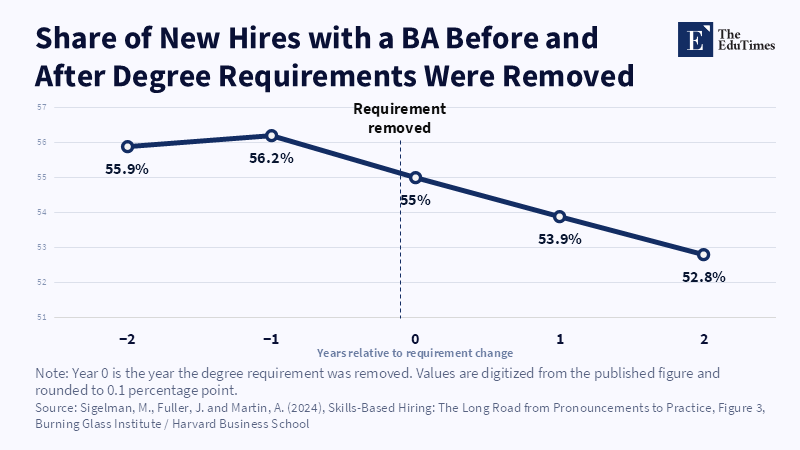
Less than one in seven hundred hires changed because a company took down the degree requirement from a job posting. The finding comes from an analysis of thousands of actual hires in the United States and is in stark contrast to what companies state. Eight out of ten employers say they have adopted a hiring policy based on skills rather than qualifications. In practice, almost nothing has changed where it matters most. This distance between rhetoric and real practice is not the hypocrisy of human resources departments. It is symptomatic of a deeper realignment of what businesses consider valuable in an employee now that AI has changed the cost of skill.
Three Forms of Human Capital in the AI Economy
Businesses are no longer just looking for "good employees". They are looking for three specific types of human capital. The first is the irreplaceable specialist, the person with such deep training in a subject that he is not easily replaced by either a colleague or a software tool. In many scientific and technical fields, the master's degree functions as the minimum evidence of this profundity, not because it teaches something magical, but because it requires time and perseverance that cannot be easily feigned. The second type is the flexible worker, one who can fill ten separate roles instead of the company needing ten different people. The third type is the manager, the one who knows how to combine the irreplaceable with the flexible so that they produce something greater than their sum.
The category that has changed radically in the last three years is the second. The flexible worker of the past needed years of experience to fill multiple roles reliably. Today, equipped with AI tools, a person can produce work that used to require an entire team of skilled employees. This new type of worker is called superhuman labor, not because he possesses supernatural abilities, but because his performance far exceeds what he could produce on his own without technological aid. The existence of this category drastically changes what "good enough" means for a graduate with only a degree.
How AI Changes the Value of Experience
The most documented evidence of this shift comes from a study of about five thousand customer service employees at a large American software company. Those who gained access to an AI tool increased their productivity by fifteen percent on average, but the profit was not evenly distributed. Inexperienced and less trained workers improved much more than experienced ones, as the tool directly conveyed to them the good practices that normally took years to acquire. In other words, AI acted as a condensed experience, closing the gap between the newcomer and the veteran in wide-ranging tasks.
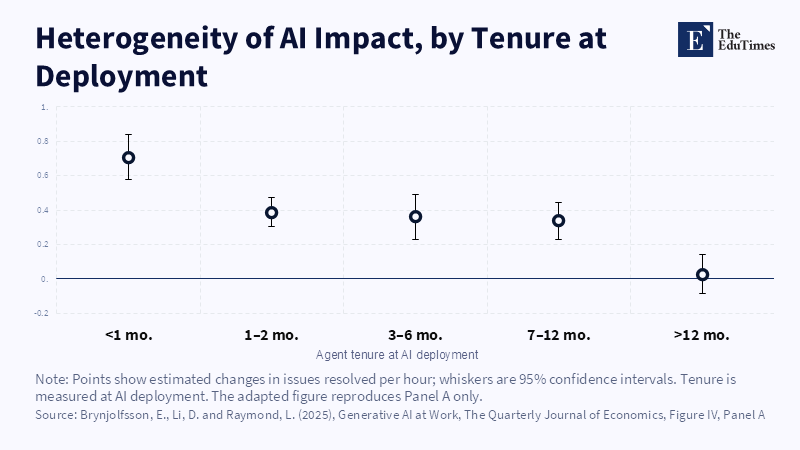
It is precisely this dynamic that gives rise to superhuman labor and at the same time explains why the simple degree is losing ground in some fields. If a tool can transfer in a few months knowledge that used to take years of experience, then the value of the breadth of knowledge offered by a four-year degree is relatively reduced, because it can now be reproduced cheaply with the help of software. What is not easily replicated is the deep, niche judgment in a narrow field, the kind of training that is built through years of structured study and research. This explains why employers continue to demand advanced degrees exactly where irreplaceability matters most, while easing requirements where flexibility is enough and technology can fill the gap.
Why the Market Is Repricing Degrees
Data from analyses of tens of millions of job advertisements show exactly this dichotomy. Between 2017 and 2019, almost half of middle-skilled positions relaxed the degree requirement, while in high-skilled positions this percentage was significantly lower, around thirty-one percent. The difference is not accidental. In medium-skilled positions, where the required skills are often broad and transferable, technology and experience can now replace part of formal education. In highly skilled positions, where documented deep knowledge is needed, employers remain wary of replacing it with something less verifiable.
This repricing also explains the gap between what companies state and what they do when they hire. Public commitment to skills instead of titles works well as an announcement because it broadens the pool of candidates and improves the company's image. But when it comes time for the real choice, especially for roles where a mistake costs dearly, the degree remains the cheapest and fastest trust badge available. The degree did not disappear because the job market evolved beyond it. It simply ceased to be sufficient on its own for those who have neither specialization nor a management role, because it is precisely at this intermediate point that superhuman labor has become a cheaper alternative.
Credentials as Signals of Expertise
The habit of German-speaking countries to incorporate official academic titles into travel documents shows better than anything how seriously this mark has historically been taken. In Austria, the law allows academic qualifications to be entered on official identity documents, including the passport, if the holder so wishes. Many read it as an expression of social display. Economically, however, it is just an extreme version of the same mechanism that works in every labor market: when competence is not easily observable, institutions create hard-to-forge signals to declare it.
Criticism accusing this culture of vanity and overemphasis on headlines touches on something real, but misses the crucial point. The problem is not that the institutions value specialized training. The problem arises when society produces many more advanced qualifications than the market really needs for irreplaceable skilled roles, while at the same time there is a shortage of hands for technical professions that the economy needs just as urgently. Both can be true at the same time: the title remains a valuable brand where depth is really needed, and the education system produces a surplus of titles where the market asks for something different.
Implications for Universities, Employers and Policymakers
For universities, the conclusion is not to reduce the number of postgraduate programs in general, but to make clearer the difference between programs that truly build irreplaceable depth and programs that simply add another title on top of already general knowledge. For business managers, the clear priority is to invest in AI tools that upskill their less experienced employees, because that is where the biggest and fastest productivity gain lies, as the study in customer service clearly showed. At the same time, realism is needed about where human expertise is really needed, which no tool can yet replace.
For policymakers, the challenge is twofold. The European Union is experiencing persistent shortages of technical occupations in many sectors, while at the same time the supply of holders of senior qualifications continues to increase in areas where demand is not catching up. The solution is not to devalue the master's degree or to uncritically praise technical education as a panacea. A clear targeting of public resources is needed in two directions that today compete unfairly for prestige and funding: deep specialization that no tool replaces, and technical training that the economy is asking for without finding it.
The statistics with which this text began are not just a curiosity for recruitment departments. It is the symptomatic sign of a labor market that has already been rearranged around three realities, even if the public debate continues to talk about one. Companies did not abandon credentials, they redistributed them around specialization, the flexibility that technology now enhances and the management of these two resources. As long as the public debate remains stuck on the question of whether we need fewer or more master's degrees, the more difficult it becomes to build the two educational paths that the market is really asking for. It is time for universities, businesses and governments to openly plan for this dichotomy, rather than treating it as if it were yet another prestige dispute between academics and craftsmen.
This article reflects the analytical judgment of The EduTimes Editorial Board and does not constitute policy advice or the official position of any affiliated institution.
References
Brynjolfsson, E., Li, D. and Raymond, L. (2025) 'Generative AI at work', The Quarterly Journal of Economics, 140(2), pp. 889–942.
Bundesministerium für Bildung, Wissenschaft und Forschung (2024) Use of Academic Degrees. Vienna: Republic of Austria.
European Labour Authority (2024) EURES Report on Labour Shortages and Surpluses 2024. Brussels: European Labour Authority.
Fuller, J.B., Langer, C., Nitschke, J., O'Kane, L., Sigelman, M. and Taska, B. (2022) The Emerging Degree Reset: How the Shift to Skills-Based Hiring Holds the Keys to Growing the U.S. Workforce at a Time of Talent Shortage. Boston: Burning Glass Institute and Harvard Business School Project on Managing the Future of Work.
Fuller, J.B. (2024) Skills-Based Hiring: The Long Road from Pronouncements to Practice. Boston: Harvard Business School Project on Managing the Future of Work and Burning Glass Institute.
World Economic Forum (2025) Future of Jobs Report 2025. Geneva: World Economic Forum.