Quality Assurance Certifies Structure, Not Teaching

Input
Modified
Quality assurance often measures compliance, not teaching quality
Accreditation can coexist with weak learning outcomes
Outcome-based review could better protect academic standards

Eighty-two students, out of three hundred and fifty in an organic chemistry course at New York University, signed a petition of protest in 2022. They were asking for changes in the curriculum, not the dismissal of their professor. But the professor was fired shortly afterward, even though he had taught for decades at Princeton and had written one of the most widely distributed chemistry textbooks in the world.The petition was followed by the termination of Jones’s contract, turning the case into a wider debate over academic rigor and institutional responsibility. The incident shows something broader, which concerns every quality assurance system in higher education today. Certification bodies consider whether an institution has the right structures, the right documents and the right procedures. They rarely look at what's really going on inside a classroom and they almost never look at what's going on in an institution when demanding teaching becomes annoying for those who pay for it.
What Quality Assurance Really Controls
There are many types of certificates in higher education and the difference between them matters. An institution first gains recognition from the national body mandated to oversee education in its country, a status that simply allows it to operate legally. They can then seek separate accreditation for specific fields of study, from engineering to medicine, which is supposed to certify more than just legitimate operation. Each body applies its own criteria, but the logic behind most systems is quite similar and the two levels of certification often end up counting the same thing under different names. An institution completes a self-assessment report, presents evidence of its procedures and receives a visit from a team of evaluators. The ENIC-NARIC network in Europe bases its quality assurance tool on six standards, which derive from the Lisbon Convention, combining self-assessment with external peer review. Twenty-one centers have been involved in this process since 2016 and most have acted on the recommendations received. A parallel tool, designed for universities themselves and not for national recognition bodies, checks whether institutions comply with European Standard 1.4 on recognition procedures, a standard that also refers to procedural compliance rather than measurable teaching quality.
This process has real value. It reveals blind spots that the institutions themselves had not identified, helps transparency and gives centers arguments to claim funding or formal legal status. However, it mainly examines whether the correct procedures exist, not whether these procedures produce good teaching. Seventeen of the twenty-one centers, i.e. 80.9%, implemented the recommendations gradually, due to limited resources and legislative obstacles. This percentage shows how slowly improvement moves, even when the assessment correctly identifies the problem. Quality assurance, as applied today, mainly rewards the completeness of the dossier. The quality assurance system has neither the tools nor the mandate to walk into a classroom and judge whether a professor teaches organic chemistry well,or whether he is just following the curriculum on paper.
When Academic Rigor Becomes a Management Risk
The New York case seemed extreme when it became known. Today it seems less rare. Professors with demanding courses often face pressure to relax the evaluation criteria, not because the criteria are incorrect, but because student dissatisfaction quickly translates into a risk to the reputation of the institution and to student retention rates. The professor of the case had observed a decade of decline in student performance, a trend that was accelerated by the pandemic. The difficulty level of the course remained constant, but more and more students found it difficult to respond. The university had other options before reaching the dismissal, such as revising the grading scale or offering additional hours of support. The university chose the response that treated the issue primarily as a management problem rather than a pedagogical one.
No accreditation body had a reason to get involved, because the issue did not touch on any of the categories that an inspectorate usually checks. There was no violation of procedure, incomplete record or absence of documentation. The curriculum officially remained unchanged. From the perspective of a certification body, nothing has changed. In reality, however, something fundamental has changed. One institution has shown that academic rigor can cost a professor of international prestige their position, without any quality assurance system recording the fact as a quality problem. This lack is not accidental. Most evaluation mechanisms were built around questions such as whether there are sufficient qualifications of teaching staff or whether learning outcomes are recorded in a document, not around whether an institution protects or abandons demanding teaching when it becomes unpleasant in part of its class.
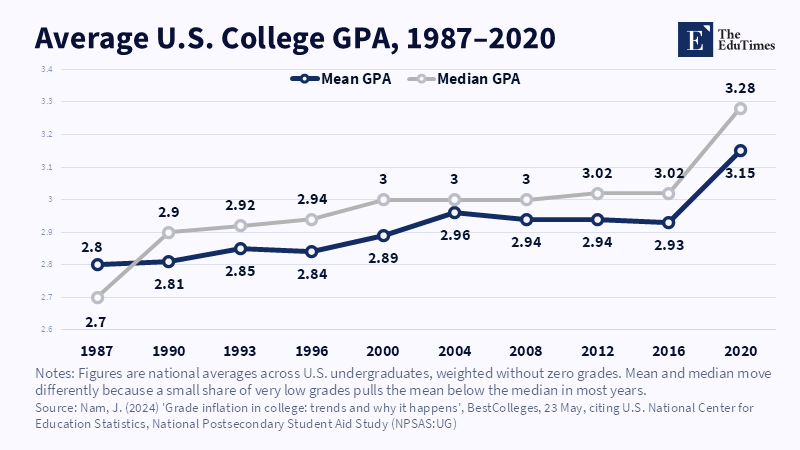
The drop in student performance described by the professor is not an isolated phenomenon. Observers of American higher education have for years pointed to a gradual shift in priorities, from teaching based on strict criteria to a more student-centered approach, in which heavy grading is now considered an outdated method. This change makes sense when it is accompanied by better student support. But it becomes a problem when it acts as a substitute for support, lowering the bar instead of helping students reach it. Most accreditation frameworks do not routinely measure whether declining standards reflect better student support or simply a lower academic threshold. National grading trends provide additional context: average and median U.S. college GPAs have risen substantially over recent decades.
Latin America’s Warning: Compliance Without Improvement
Chile has one of the most developed quality assurance systems in Latin America, with an institutionalized framework and a strong accreditation body, the National Accreditation Commission. On paper, the system works well. An analysis published in 2026, however, described a system more capable of evaluating than causing real change. Institutions can fully comply with standards, maintain well-organized internal processes and receive accreditation while making limited progress in student learning, program retention or research performance. Some institutions received an "advanced" or "excellent" rating, despite doubts about their true effectiveness in areas such as strategic leadership or the social impact of their research. Institutions gather extensive data on grades, graduation rates and labor market uptake, but this data rarely shapes actual decisions.
Earlier analysis by the same author, from 2023, identified a similar pattern across the region. Only ten Latin American universities were then among the top five hundred institutions in the world in the Shanghai rankings and only 2.25 percent were among the top four hundred of the Times Higher Education rankings. In Colombia, the national accreditation system has been criticized for excessive bureaucracy that delays self-assessment processes. In Chile, the minutes of accreditation decisions are published with a delay of up to six months. Self-assessment reports are described as voluminous and descriptive documents that lack real analysis and yet are accepted as a starting point for the accreditation process. Competition between institutions has also led to standardized curricula, with little actual differentiation between similar departments. Quality assurance, in this context, has acted more as a reference mechanism than as a guidance tool.
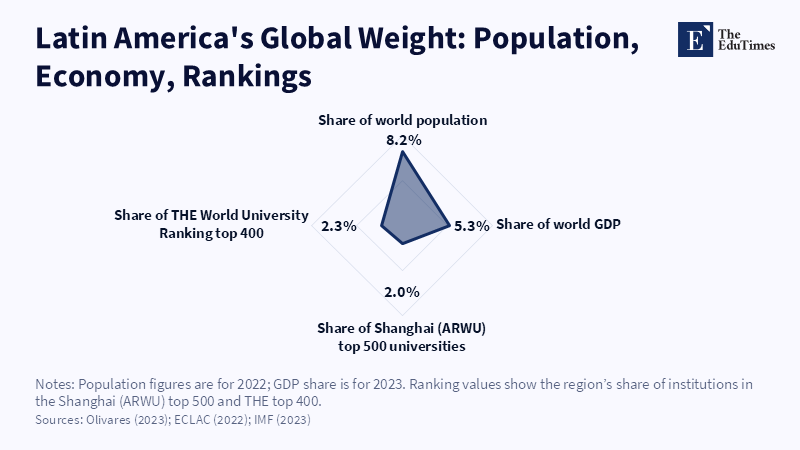
The scale of the issue is not small. Latin America and the Caribbean account for 8.2% of the world's population, about six hundred and sixty-two million people, with a significant share of young people entering higher education each year. A quality assurance system that primarily assesses bureaucratic compliance therefore affects millions of graduates, not a marginal group of institutions. The same analysis noted that only a few studies have systematically examined the true impact of these systems on the region, making it difficult to even identify the problem, let alone fix it.
From Accreditation Checklists to Learning Outcomes
An example from Ethiopia shows what could change. As the country strengthened the qualifications of its graduates, some authorities began to expect all institutions to adopt the same curriculum model, based on learning outcomes. However, the country's national qualifications framework does not impose a single methodology. It recognizes that different institutions can achieve the same educational outcomes through different pedagogical approaches. The country's legislation also recognizes the autonomy of institutions to design their own curricula, as long as they align with national qualification standards. Internationally, well-functioning quality assurance bodies assess whether a program has clear learning outcomes, a coherent curriculum, reliable evaluation, appropriately qualified staff and adequate resources. They rarely impose a specific teaching model that every institution must copy. The difference between principles and recipes may seem technical, but it determines whether a quality assurance body actually controls results or simply enforces uniformity.
The research shows something even more useful. The quality of a curriculum depends less on the label it carries, such as 'competency-based' or 'results-based' and more on how it is implemented in practice. Good teaching, meaningful student involvement, valid evaluation, adequate learning resources and consistent academic leadership impact graduate success much more than adhering to a specific framework. A self-assessment tool developed in 2022 by a consortium of European university associations was recently tested by forty-three institutions in seven countries. The institutions reported a better understanding of the recognition procedures and an evidence base for internal dialogue, without imposing a single assessment model on them. One could argue that evaluating results costs more time and staff than a simple document verification. The argument is valid, but the same evidence shows that the additional costs are attributed to better exchange of practices between institutions and fewer findings that ultimately remain unfollowed. For institutions with limited capacity to conduct a full evaluation, a lighter version of the same tool was developed, specifically designed so that a lack of resources would not be an excuse for a complete absence of an evaluation of results. This model shows that the transition from compliance to substantive assessment does not necessarily require huge resources, but rather a different design of the tools themselves.
The New York professor did not lose his position because he failed an accreditation check. No audit ever looked at whether its rigor was an asset or a problem. This is exactly the gap that quality assurance needs to fill. Certification bodies need to move from dossier review to outcome evaluation, publish their findings without delays of months and compare real learning data instead of accepting descriptive self-assessment reports. The six-criteria model, the forty-three institutions' self-assessment tool and the rest of the initiatives show that there is a technical possibility for something better. What is missing is the political will to measure teaching, not just its documentation. Until this happens, an institution will be able to lose its most demanding professors and still retain any certification it holds. The next time such a professor is faced with a complaint report, the question that a quality assurance system should ask is not whether the institution adhered to the correct dismissal process, but whether it maintained the level of education it promised its students when it enrolled them.
This article reflects the analytical judgment of The EduTimes Editorial Board and does not constitute policy advice or the official position of any affiliated institution.
References
Adamu, A.Y. (2026) ‘Quality assurance should not prescribe curriculum models’, University World News, 16 July.
Economic Commission for Latin America and the Caribbean (ECLAC) (2022) ‘The world has 8 billion people, 662 million of whom live in Latin America and the Caribbean’, 14 November.
International Monetary Fund (IMF) (2023) World Economic Outlook: Navigating Global Divergences. Washington, DC: International Monetary Fund.
Mincer, E. (2022) ‘Chemistry professor at NYU fired for making the class “too hard”: Thoughts from a former STEM major’, The Lamron, 11 November.
Nam, J. (2024) ‘Grade inflation in college: Trends and why it happens’, BestColleges, 23 May.
Olivares, C. (2023) ‘Quality assurance must go beyond bureaucratic compliance’, University World News, 28 January.
Olivares, C. (2026) ‘Something important has been lost in quality assurance’, University World News, 27 May.
van Dierendonck, M. and Lokhoff, J. (2026) ‘How to boost the power of quality assurance in recognition’, University World News, 6 August.