Time Served, Not Skill Gained

Input
Modified
AI is weakening the case for fixed credit hours
Shorter degrees can work without reducing academic quality
Accreditation should measure competence, not time served

Ninety campuses in the United States now offer a bachelor's degree that takes three years instead of four. Almost sixty of them started under a coordinated banner in the last two years alone. A decade ago this number would have sounded marginal, but it doesn't sound marginal now. Students, families, and finance ministries keep asking the same question. Why is a credential still measured in hours spent in a room, when the room itself has changed so much? AI now writes a first pass of an essay, checks a proof, translates a source document, and summarizes a case file in seconds. Meanwhile, the accreditation rules that govern most universities still measure teaching hours, not what a graduate can actually do. This mismatch is the real failure of policy, and it matters more than the duration of any single degree.
Why A Century-Old Clock Still Runs The University
Credit Time didn't start as an academic idea; it started as an insurance calculation. In 1906 the Carnegie Institution built a unit worth 120 hours of classroom contact. The original purpose was narrow, setting a standard for deciding which retired teachers qualified for retirement. This unit became the backbone of enrollment, financial aid, and faculty workload in thousands of institutions, and still holds this role today. A typical bachelor's degree in the United States works with about 120 credit hours. Each is made up of a semester of sedentary teaching plus the expected homework. No one designed this number around what a graduate needs to know until the end. The system survived for a simpler reason. Auditing hours are easy. Learning auditing is difficult, and universities chose the path of least resistance a century ago, without ever fully rethinking it.
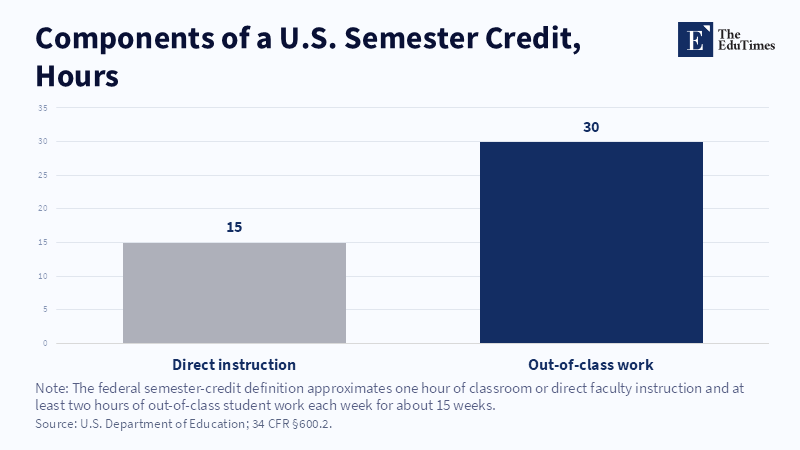
The logic behind the system has moved little since then. Regulators, lenders and rating agencies rely on credit time because it produces a clean, comparable number. A secretary can prove that a student sat for several hours. Proving that the same student learned to reason, write, or diagnose a problem under pressure is a much more difficult task for a teacher. Convenience kept the clock running, not pedagogy. Chile shows a version of the same pattern from a different perspective. The universities there fold academic education and professional certification into a single five-year or six-year path. The timetable determines when a lawyer or engineer is ready to practice the profession. A defined, tested result does not. This gap is at the heart of the current debate in Santiago.
One Degree, Five Different Clocks
Comparing degree length between countries only works when the underlying credit systems are honestly compared. They count completely different things. The American Carnegie unit measures the time of positions. The European Credit Transfer and Accumulation System, created through the Bologna reforms, instead measures the total workload of students. One credit there equals approximately twenty-five to thirty hours of combined lectures, independent study, and evaluation. A full academic year is worth sixty credits, regardless of how those hours are distributed on the calendar. The UK is closer to the American model. A typical three-year degree with honors takes about seventy-nine weeks of actual instruction. This number is low. A vice-chancellor at City St George's of the University of London suggested compressing it to two fuller years of forty weeks of teaching each. The design preserves the content and only removes the large, unstructured gaps between terms.
Chile also inherited a version of the sit-time model. He focused on the additional task of professional licensing, which most OECD systems delegate to separate bodies after graduation. A Chilean student who trains to become an engineer or lawyer studies for five years and comes out certified to practice the profession immediately. An American or British graduate leaves with an academic credential. This graduate often goes on to train on the job, or through separate professional bodies, for several more years before reaching an equivalent position. The total years invested in a career can end up similarly in both systems. What differs is which institution the watch belongs to. What also differs is how rigidly this watch is treated as the basis for the skill, rather than a container skill that happens to sit inside.
None of this suggests that any country did the arithmetic correctly. He proposes something narrower and more useful: hours were never a neutral, global currency in the first place. Defending a fixed number of hours as if it were a fact of nature becomes more difficult to justify when the comparison sits side by side like this.
What AI Has Already Removed From The Academic Workload
The strongest case for reviewing credit hours now comes from what production tools have already taken over, not some more uncertain future. Writing a first outline used to eat during lesson. So is running a standard statistical test, producing stereotyped code, or summarizing a stack of documents. The slow execution of these tasks was once treated as part of the training itself. AI tools now compress this task into minutes. A lesson that is still budgeted around the old working time ends up counting the wrong thing. It tracks how long a task took, not what a student has learned from performing it.
Reducing hours doesn't automatically improve anything, and American critics of three-year degrees have issued a fair warning on this point. The American Association of University Professors argued in a statement in mid-2026 that stripped degree paths risk trading meaningful intellectual growth for speed. Forbes contributor Christopher Rim made a relevant point in his own comment. He noted that the irrelevant elective course, or the random double course, is often exactly where adaptive, interdisciplinary thinking is built. This is the kind of skill that AI doesn't replicate easily, at least not yet. Both reviews deserve to be taken seriously. The correct answer is not to defend fixed working hours as the basis for this depth. A better response designs accreditation around the proven scope and judgment directly. This frees up the hours that AI has made redundant for the exploratory, connecting work that these critics want to protect. Universities can stop spending those hours on tasks that a machine finishes now before class even starts.
When Competence Replaces Time
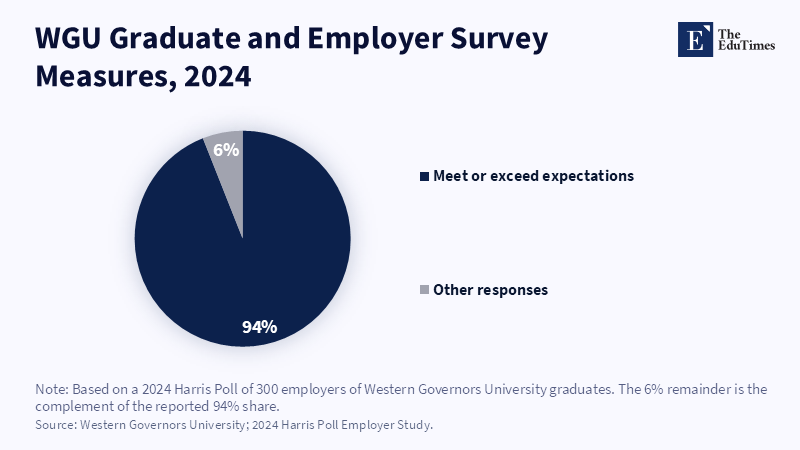
Skeptics could reasonably ask whether a results-based model can work at real scale, and the answer already exists. Western Governors University operates entirely with competency-based education. It awards credit as soon as a student demonstrates mastery, not after a set number of weeks in a course. More than two hundred and ten thousand students enrolled there in the 2024 to 2025 academic year. This made it the largest university in the United States by enrollment. A 2024 Harris Poll survey found that ninety-four percent of recent graduates were employed. Each of the three hundred employers surveyed rated WGU graduates as job-prepared. This is no longer a fringe experiment. It is functional proof that time and learning can be separated without collapsing the institution.
Public trust in the traditional model, meanwhile, has been slipping for years, and this decline is part of the reason why the pressure for reforms continues to grow. The Sutton Trust poll is based on the long-standing British Social Attitudes survey. The percentage of people who believe that a degree is not worth the time and money has more than doubled between 2005 and today. It moved from fourteen percent to thirty-three percent. The percentage who believe that graduates end up in a much better financial situation fell over the same period, from about half to just over a third. Nothing from this decline proves that the credit hours system alone caused the drop in confidence. The numbers show that the current model is losing disagreement with the audience it is intended to serve. This gives reform efforts real political space to work with.
For policymakers, practical change is narrower than it sounds. Accredited ones do not need to abolish overnight credit time. What they need is a second, parallel route that directly certifies the capability. Engineering licensing boards are already doing something similar, testing branded skills rather than logged hours. The Chilean Ministry of Education could pilot just this alongside the existing five-year route, without disrupting the programs that still operate under the old model. Funding bodies face the same adjustment. Student loan systems based on fixed years of study would need a new formula. This formula should link funding to verified modules that have been completed, not semesters that have been tracked, before any of them become more than just a topic of discussion. This is an administrative problem. It is not impossible, and many of the above American examples show that it can be solved within existing legislation, not around it.
U.S. regulators have begun to formalize capability-based pathways elsewhere as well. The Higher Education Commission is now approving degree programs below the usual minimum threshold of one hundred and twenty points. By April 2026, institutions in twelve states had been licensed to run reduced credit degrees under this pathway. The University of Wisconsin Green Bay certified a computer science degree with one hundred credits instead of one hundred and twenty. It became the first campus in its state system to do so. The entire California state university system approved three-year selections on all twenty-two campuses in the same year. The details vary from state to state. The direction remains constant in almost all of them, pointing towards accreditation linked to verified competence rather than a fixed count of hours.
Where Efficiency Becomes Erosion
The clearest warning against the rush of this change comes from medicine and cuts in an unexpected direction. Buckingham Palace University has had a compressed medical degree as of 2019. It covers the same syllabus as a typical five-year or six-year program, but in four and a half years. The compression comes primarily from cutting long summer vacations rather than trimming content, and the program maintained full accreditation from the General Medical Council throughout. Its graduates have progressed to typical graduate placements at about the same rate as their peers from larger programs. The lesson here is accurate, not sweeping. Shortening a timeline didn't hurt quality when cuts were aimed at unused time rather than meaningful learning. Programs that cut elective courses, general education, or supervised practice just to hit a smaller number risk something different. This is the outcome that AAUP warned about: a credential that arrives faster and teaches less.
Dead time compression and learning compression are two different things. Accreditation frameworks in Chile, the United States, the United Kingdom, and continental Europe have yet to incorporate this distinction into their next review. None of them ask this question directly. All of them still ask how many hours a student sat. Ninety American campuses did not begin experimenting with smaller degrees because the four-year calendar suddenly became sacred and needed advocacy. They started because families noticed the gap between what is supposed to certify a credit hour and what actually counts on the spot. Accrediting bodies that continue to avoid this gap will find institutions and students working around them anyway. This solution will happen informally and unevenly, serving no one as well as an honest rewriting of the rule would.
This article reflects the analytical judgment of The EduTimes Editorial Board and does not constitute policy advice or the official position of any affiliated institution.
References
American Association of University Professors (2026) Three-Year Bachelor's Degrees Devalue Student Education and Do Nothing to Address the Root Cause. Washington, DC: American Association of University Professors.
Blackman, T. (2025) A Call for Radical Reform: Higher Education for a Sustainable Economy. Oxford: Higher Education Policy Institute.
Carnegie Foundation for the Advancement of Teaching (2026) What Is the Carnegie Unit? Stanford, CA: Carnegie Foundation for the Advancement of Teaching.
Corey, S. M. (2026) Three-Year Bachelor's Degrees: Why Higher Education Should Shorten the Path, Not the Purpose. Olivet, MI: The University of Olivet.
Datta, J. (2026) Degrees Still Matter: The System Around Them Needs Fixing. London: The Sutton Trust.
European Network of Information Centres and National Academic Recognition Information Centres (2026) European Credit Transfer and Accumulation System (ECTS). Brussels: ENIC-NARIC Network.
Rim, C. (2026) 'What both sides of the three-year college degree debate are getting wrong', Forbes, 31 July.
Rowsell, J. (2026) 'Shorten UK undergraduate degrees to just two years, says v-c', Times Higher Education, 9 March.
Sánchez, I. (2026) 'Should university degrees be shortened? The debate continues', University World News, 6 August.
Tooley, J. and Harris, J. (2023) 'Shortened medical degrees: a threat to quality?', HEPI Blog, 11 September.
Western Governors University (2025) Outcomes That Endure: WGU's FY2025 Annual Report. Salt Lake City: Western Governors University.