Academic Ranking and Neighborhood Context: What Test Scores Miss

Input
Modified
Local academic rank predicts later educational outcomes
Neighborhood context changes how achievement should be interpreted
Admissions should test contextual measures alongside national scores

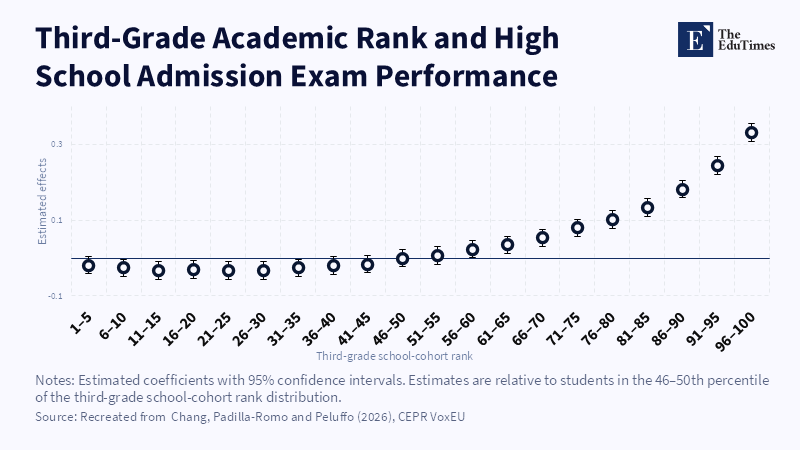
Two children can perform exactly the same in third grade and, years later, reach the crucial admissions test with a noticeably different result. In Mexico City, one student could be about in the middle of their school's academic rankings and another in the top 5 percent. The higher position is associated with about one-third of the standard deviation higher performance on the later admissions test. The initial score had already been taken into account. This makes the academic ranking more than a table of winners and losers. It shows that the same score takes on a different meaning depending on who is around the student, what expectations the environment creates and how many opportunities there are for learning. If neighborhood and peers produce positive externalities, then local performance may reveal some of the academic potential that a national test leaves hidden.
What Academic Ranking Reveals in Mexico City
The admission system to the public high schools of Metropolitan Mexico City offers a rare insight into this process. Candidates declared up to 20 schools in order of preference and took a common admission test. The final placement depended on preferences, score and available places. Researchers linked this data to the third grader's older performance. So they were able to compare students with similar starting scores but different positions within their own school's distribution. This point is of great importance. Academic ranking added information beyond grade. Two children with the same standardized performance could be in a completely different position because the performance of their classmates differed. The study showed that this relative position left a trace several years later, when students had already changed classes, teachers and immediate environment.
The results were not limited to the test. Students with higher early academic rankings reported more selective high schools, had higher aspirations for university studies and described themselves as more persistent, organized and consistent in schoolwork. The study also did a hypothetical exercise. If students in the 46th to 50th percentile of the original ranking had been in the 76th to 80th percentile, about 11 percent would have been placed in a school that had been stated as higher in their preferences. The effect also seemed stronger in students with fewer socioeconomic resources. The finding matches research in England, the United States and, more recently, experimental data from Ecuador. Position within the classroom can change future effort, confidence and ultimately learning itself.
The easy interpretation would be that students who seem strong in a weaker group gain high self-esteem and invest more in themselves. This is part of the story, but not the whole story. In Ecuador, where students were randomly assigned to classes each school year, children with the same starting ability could only find themselves in a different academic ranking because of the composition of the class. A higher position at the beginning of the year improved performance at the end, especially at younger ages and was also associated with better executive function, greater happiness and more positive evaluation by teachers. The relative position, therefore, can change behavior and learning. At the same time, however, the composition of peers can directly affect how easy or difficult it is for a student to reach a certain score.
How Neighborhood Context Shapes Academic Performance
The hypothesis of positive externality becomes stronger when the classroom is placed within the neighborhood. A child does not arrive at the test having received only hours of instruction. He arrives with different sleep, safety, access to quiet space, commute time, housing quality, exposure to violence, cultural stimuli and peer expectations. A large study published in Science in 2026 mapped 649 variables on brain function and structure data from nearly 12,000 children aged 9 and 10. Socioeconomic indicators had the strongest and most repeatable correlations. The opportunity associated with the zip code was the strongest individual correlation, while a common socioeconomic pattern explained about 34 percent of the variation in brain association maps. The study cannot prove that neighborhood determines intelligence. The finding shows how deeply the environment can penetrate into the conditions in which performance is measured.
Data from Mexico makes this difference more concrete. Exposure to violent crime the week before a critical test reduced girls' performance by about 0.11 standard deviation. Among exposed girls, 19 percent subsequently ended up in less preferred and lower-quality high schools. Another study looked at student violence and immigration in Mexico. The arrival of a new student who had previously been exposed to local violence, in a class of 20 children, reduced the performance of already enrolled students by about 0.02 standard deviation. The effect was small on an individual level, but it shows the mechanism. One student's experiences can pass into the classroom and influence others. If negative shocks can be transmitted through peers, it is reasonable to consider with equal seriousness whether positive conditions can work in the opposite direction.
This does not mean that every neighborhood effect passes through the people who live next door. In American data, a 5 percentage point increase in the share of school peers whose parents had been arrested was associated with a drop in performance by 0.016 standard deviation. It was also associated with a 5 percent higher adult arrest rate. The analysis showed that the key mechanism lay mainly in interactions within the school and less in direct neighborhood contacts. This reinforces a more cautious version of the case. The neighborhood shapes who meets in schools, what pressure reaches the classroom and what resources a community gathers. Positive externality can therefore be local without being literally the result of only the children living next door.
The clearest indication comes from cases where the environment changed without simply being chosen by families. In London, social housing renovations that brought higher-income households to poorer areas were associated with better performance of low-income students at the end of primary school. The analysis estimated that schools explained 65 percent to 81 percent of the overall improvement and that a significant portion was going through changes in the composition of the student population. Earlier experimental data from the Moving to Opportunity program in the United States also show that exposure to lower-poverty neighborhoods before 13 had strong long-term consequences. Children who moved young had an average of 31 percent higher income in their mid-twenties. The area of residence is involved in the process that produces skills, expectations and opportunities.
Academic Ranking as a Signal of Hidden Potential
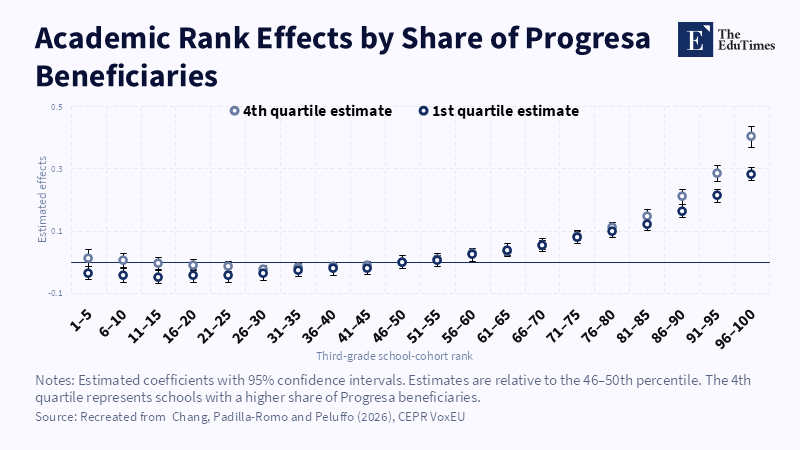
If two students have the same national score, the score does not need to be read as an equal indication of their effort or future potential. The student who arrived there in an environment with lower school performance, more insecurity and fewer academic opportunities may have faced stronger limitations. If they were at the same time very high in the local academic rankings, this adds information that the national test does not have. It does not demonstrate higher innate intelligence. Such an interpretation would be scientifically exaggerated. But it can be a sign of perseverance, steady effort, the ability to utilize limited resources and a possible response to a better learning environment. For options with limited places, this information has value.
The objection is obvious. A high academic ranking in a weak school may simply reward the student for having fewer strong competitors. If this indicator gains a lot of weight, two equal national scores could be treated differently for reasons unrelated to actual knowledge. The risk is there. That's why local ranking should not replace the common examination. It should act as a second signal, along with the national score and a clear area opportunity index. Ranking research itself shows why this balance is needed. In England, an increase in a standard deviation in primary school rankings was associated with about 0.08 standard deviation higher performance at 14 and 16. In Texas, the highest ranking in third grade predicted more advanced courses, high school graduation, college attendance and completion and even higher incomes 19 years later.
There is a second reason to use the framework sparingly. Academic ranking can become a self-fulfilling signal. A student who has been hearing for years that he or she is one of the best can ask for more difficult courses, declare more challenging schools and persist longer when he or she fails. This is a real educational effect, but it does not identify with a fixed quality of the individual. For the admissions officer, a more useful question is which student is most likely to take advantage of an additional opportunity, given what they have had available to date. Local rankings and neighborhood conditions can help with this prediction in two ways. They must add information beyond the common test and the result must be repeated in different groups of students.
The most important thing is not to create the wrong motivation. Policy should not keep a competent student in a lower-performing school just to stay first. A better school can lower its relative position and at the same time increase real learning through better classmates, higher expectations and more resources. The loss of the advantage of academic ranking can be met with counseling, feedback that shows absolute progress and support during the transition. The positive externality of peers requires that self-confidence is protected and the transition is planned more carefully. A student must be able to enter a stronger environment without interpreting the new, lower position as evidence that he has suddenly become less competent.
How to Measure Neighborhood Effects
Wealthy families more often choose safe areas and good schools. More ambitious parents may also move for the sake of education. A simple comparison between two zip codes would confuse the effect of the neighborhood with the characteristics of the families living there. Plans that come close to random change are needed. Such opportunities are provided by the random allocation of students to classes in Ecuador and public housing rules. The same is true for rezoning that changes the composition of an area, sudden movements due to violence and admission systems with clear boundaries. A single "ghetto index" or a simple average neighborhood grade would be too rough. It needs to be separately assessed what peers add, safety, school, housing stability and access to resources.
A practical admissions system could thus keep the national grade as a key measure of knowledge and add a limited, transparent adjustment for context. Academic ranking within the school would provide information on relative performance. An opportunity index would capture elements such as area income, poverty concentration, security, access to libraries, commute time and stability of school attendance. The value added by the school itself should be calculated separately so that a challenging environment is not confused with low-quality teaching. The weights of these elements should not be decided politically in advance. They should be checked against historical data and selected only if they improve the prediction of future performance without creating new arbitrary inequalities.
A third of the standard deviation indicates something more substantial than a story of self-confidence. Measuring performance loses information when it ignores the environment in which it was produced. Academic ranking can help recover some of this information, as long as it is not baptized as a measure of innate ability. The next step for educational authorities and admissions systems is specific. Pilot tests are needed that compare the simple national score with models that add local rankings and verified opportunity indicators. If these models consistently identify students who later overperform, then the neighborhood ceases to be an invisible factor of injustice and becomes a measurable part of a more accurate assessment.
This article reflects the analytical judgment of The EduTimes Editorial Board and does not constitute policy advice or the official position of any affiliated institution.
References
Billings, S.B. and Hoekstra, M. (2023) ‘The Effect of School and Neighborhood Peers on Achievement, Misbehavior, and Adult Crime’, Journal of Labor Economics, 41(3), pp. 643–685.
Cameron, C. (2026) ‘Children’s zip codes change their brains’, Scientific American, 11 June.
Carneiro, P., Cruz-Aguayo, Y., Salvati, F. and Schady, N. (2025) ‘The Effect of Classroom Rank on Learning throughout Elementary School: Experimental Evidence from Ecuador’, Journal of Labor Economics, 43(2), pp. 433–466.
Chang, E. and Padilla-Romo, M. (2023) ‘When Crime Comes to the Neighborhood: Short-Term Shocks to Student Cognition and Secondary Consequences’, Journal of Labor Economics, 41(4), pp. 997–1039.
Chang, E., Padilla-Romo, M. and Peluffo, C. (2026a) ‘Persistent Effects of Early Academic Rank on Cognitive and Noncognitive Outcomes’, NBER Working Paper No. 35267, National Bureau of Economic Research.
Chang, E., Padilla-Romo, M. and Peluffo, C. (2026b) ‘How early academic rank shapes high school choices and admissions’, VoxEU.org, Centre for Economic Policy Research, 22 August.
Chetty, R., Hendren, N. and Katz, L.F. (2016) ‘The Effects of Exposure to Better Neighborhoods on Children: New Evidence from the Moving to Opportunity Experiment’, American Economic Review, 106(4), pp. 855–902.
Denning, J.T., Murphy, R. and Weinhardt, F. (2023) ‘Class Rank and Long-Run Outcomes’, The Review of Economics and Statistics, 105(6), pp. 1426–1441.
Elsner, B. and Isphording, I.E. (2017) ‘A Big Fish in a Small Pond: Ability Rank and Human Capital Investment’, Journal of Labor Economics, 35(3), pp. 787–828.
Marek, S. et al. (2026) ‘Patterns of brain-wide associations reflect socioeconomics’, Science, 392(6803), eaee6213.
Murphy, R. and Weinhardt, F. (2020) ‘Top of the Class: The Importance of Ordinal Rank’, The Review of Economic Studies, 87(6), pp. 2777–2826.
Neri, L. (2024) ‘Moving opportunities: The impact of mixed-income public housing regenerations on student achievement’, Journal of Public Economics, 230, 105053.
Padilla-Romo, M. and Peluffo, C. (2023) ‘Violence-induced migration and peer effects in academic performance’, Journal of Public Economics, 217, 104778.
Wodtke, G.T., Yildirim, U., Harding, D.J. and Elwert, F. (2023) ‘Are Neighborhood Effects Explained by Differences in School Quality?’, American Journal of Sociology, 128(5), pp. 1472–1528.