Research Impact Should Be the Real Measure of a University's Rank

Input
Modified
Research impact, not paper volume, should be the core measure in university rankings
Collaboration should count only when it builds real capability, not just co-authorship
Students increasingly choose schools by prestige and payoff, not ranking methodology details

A recent University World News piece asked a sharp question: do global rankings reward genuine research collaboration or do they just reward dependence on richer partners? The article showed that international co-authorship gets treated as a straightforward positive signal across most ranking systems, even though the reality behind that signal is messy. A university that leads a project, trains the researchers and owns the core data is doing something very different from a university that appears as a minor co-author on someone else's paper. Both get counted the same way. That is the flaw worth sitting with. However, the collaboration question is really a symptom of something bigger. Rankings across the board have started to lose their grip on students, parents and employers, not because people stopped caring about quality but because the logic behind the numbers often doesn't hold up. Fewer families are willing to pay tuition based on a badge. They want proof the degree changes something.
Collaboration or Dependence: Why the Question Is Framed Wrong
Ask a researcher at a top-tier department how they weigh a stack of Q4 papers against a single Nature or Science publication and you won't get much hesitation. Many elite departments barely register Q3 or Q4 work as a real publication record at all. They treat it as noise. For A-class researchers, the comparison between volume and impact isn't much of a debate.
Yet national accreditation bodies rarely apply that same standard. Q3 and Q4 journals stay eligible and for good reason from the accreditor's side: the schools publishing in that tier are also the schools carrying the bulk of tuition-paying enrollment. A handful of students attend Ivy-Plus and flagship institutions. Most students attend schools where faculty publish, at best, in the lower journal tiers and some of those faculty pay for the privilege of publication. Accreditation systems built around headcount and revenue have little incentive to penalize that.
This is the same failure the collaboration-versus-dependence debate exposes, just from another angle. A ranking counts a co-authored paper the same way regardless of who actually built the work. An accreditor counts a Q4 paper the same way regardless of whether anyone will ever cite it again. Both systems are optimized to be countable, not to be true.
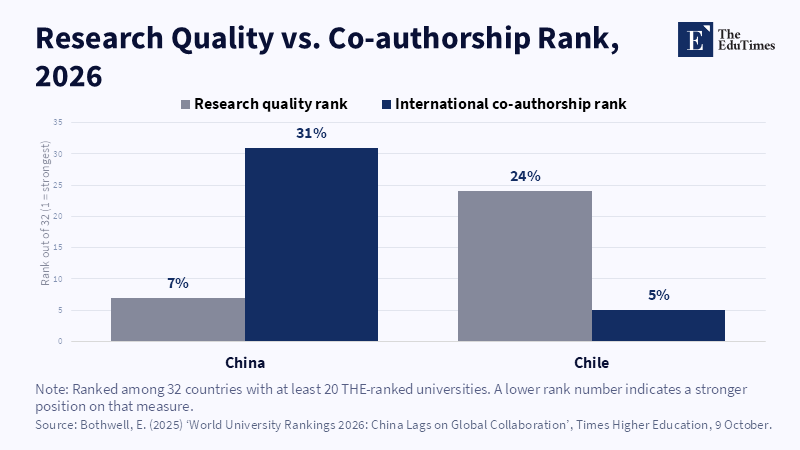
The fix isn't deciding that collaboration is good or bad or that Q3 journals should be banned outright. It's building a model that asks what a piece of research or a partnership actually contributed to a university's real capability and standing. Times Higher Education's own 2026 ranking data makes this case by accident. Researchers there found only a moderate correlation, about 0.5, between international co-authorship and research quality. Mainland China ranked seventh out of 32 countries for research quality while holding one of the lowest shares of internationally co-authored papers. Chile showed the reverse pattern: heavy collaboration, weaker research quality. If co-authorship tracked capability cleanly, that gap wouldn't exist.
Why Deference to Rankings Is Fading
A 2024 University World News piece called this the end of the "age of deference," and the phrase has aged well. Rankings once carried an unspoken authority. A school ranked in the top 50 was simply understood to be better than one ranked 300th and few people asked what sat underneath that number. That deference is breaking down, partly because ranking methodologies keep shifting their weights year over year and producing different orders for the same institutions and partly because families are running their own math now.
WICHE projects that the pool of U.S. high school graduates will peak in 2025 and then decline by roughly 13 percent through 2041, with 38 states seeing fewer graduates by 2041 than they had in 2023. A shrinking applicant pool means schools without strong outcomes data will struggle to lean on prestige-adjacent signals like accreditation status or a ranking badge. Reporting from The EduTimes has already framed this as elite concentration: as the pool of college-age students shrinks, the schools that thrive cluster at the top, while enrollment at lower-tier institutions keeps eroding.
The financial data explains why students are walking away. Researchers at the Federal Reserve Bank of New York estimated a solid 12.5 percent return on investment for the typical graduate in 2025. Their follow-up analysis, though, found that college fails to produce a positive financial return for at least a quarter of graduates. Georgetown's 2025 review of roughly 4,600 colleges reached a similar conclusion through different data: long-term return on investment varies enormously, a famous name doesn't guarantee the best value and many regional public universities actually match flagship-level returns.
Layer AI-driven labor market pressure on top of that math and the picture worsens for mid- and lower-tier schools specifically. The International Labor Organization's 2025 study found that about one in four workers globally hold jobs with some exposure to generative AI, though only 3.3 percent sit in the highest-exposure category and the ILO frames the likely outcome as task change rather than mass job loss. Even so, a degree built around generic knowledge and routine skills is a harder sell when software can replicate more of that work. Q3 and Q4-tier research schools, already struggling to justify tuition on ROI grounds, are the ones most exposed here. In a few years, the collaboration-versus-dependence debate that started this conversation may matter less than it does today, simply because the schools most affected by it will have a shrinking student base to serve.
What Students Actually Choose On
Here's the part rankings tend to miss. When students can afford to choose, they don't pick schools based on co-authorship ratios or journal quartile breakdowns. They're choosing based on prestige and social impact, the same fundamental factors that predate modern ranking methodology entirely.
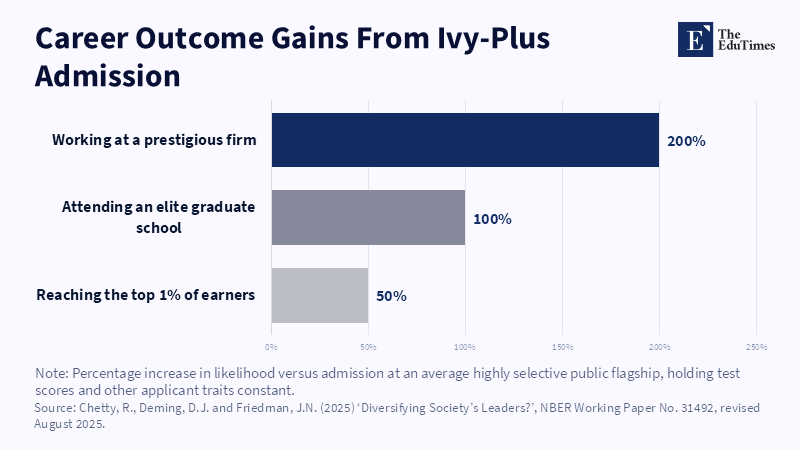
The data on this is blunt. A large NBER study, revised in 2025, found that attending an Ivy-Plus school instead of an average selective public flagship raised a student's odds of reaching the top 1 percent of earners by about 50 percent. It nearly doubled the odds of attending an elite graduate program and almost tripled the odds of landing at a prestigious firm. None of that proves an elite degree is always the smarter financial bet. It shows that certain institutions carry outsized access to high-status networks and that access is what students are actually buying, whether or not a ranking table captures it.
Research strength feeds that access loop. It pulls in leading scholars, large grants, doctoral talent and the kind of policy and industry attention that turns a university into a genuine hub rather than just a well-run school. Research impact isn't a separate metric from prestige, in other words. It's one of the mechanisms that builds prestige in the first place and that's exactly why it deserves more weight in rankings than volume-based counting currently gives it.
Building a Model That Actually Measures This
None of this means collaboration is bad or that accreditors should blacklist Q3 and Q4 journals. It means rankings need to stop treating collaboration and volume as automatic goods and start asking what they contribute to something measurable: a university's real capability and its social footprint.
A workable model would separate a few things current systems blur together. Field-adjusted citation influence and downstream signs of use, patents, clinical guidance, policy citations and licensed technology would capture actual impact rather than publication count. Lead authorship, grant control and doctoral training would capture contribution rather than mere presence on an author list. Collaboration would still earn credit but proportional to what it adds to a university's capability and standing, not simply because a co-author's address sits in another country.
That reframing solves the accreditation problem too. Accreditors don't need to disqualify lower-tier journals to raise the bar. They can ask for evidence that a small set of a school's output carries real signs of quality or use, alongside integrity and supervision standards, without pretending every Q4 paper represents genuine research capability.
The core question a ranking should answer isn't complicated, even if measuring it is hard: what did this university actually change, who built that change and did it move the school's real standing in the world? Collaboration can help answer that. Volume alone cannot. And as the students paying for these degrees keep voting with their tuition dollars, the rankings that keep confusing activity with impact will keep losing the audience they were built to serve.
This article reflects the analytical judgment of The EduTimes Editorial Board and does not constitute policy advice or the official position of any affiliated institution.
References
Abel, J.R. and Deitz, R. (2025a) 'Is College Still Worth It?', Liberty Street Economics, Federal Reserve Bank of New York, 16 April.
Abel, J.R. and Deitz, R. (2025b) 'When College Might Not Be Worth It', Liberty Street Economics, Federal Reserve Bank of New York, 16 April.
Baty, P. and Banette, D. (2025) 'World University Rankings 2026: Methodology', Times Higher Education, 22 September.
Bothwell, E. (2025) 'World University Rankings 2026: China Lags on Global Collaboration', Times Higher Education, 9 October.
Cheah, B., Van Der Werf, M., Morris, C. and Strohl, J. (2025) Ranking 4,600 Colleges by ROI (2025). Washington, DC: Georgetown University Center on Education and the Workforce.
Chetty, R., Deming, D.J. and Friedman, J.N. (2025) 'Diversifying Society's Leaders? The Determinants and Causal Effects of Admission to Highly Selective Private Colleges', NBER Working Paper No. 31492, revised August 2025.
Gmyrek, P., Berg, J., Kamiński, K., Konopczyński, F., Ładna, A., Nafradi, B., Rosłaniec, K. and Troszyński, M. (2025) Generative AI and Jobs: A Refined Global Index of Occupational Exposure. ILO Working Paper 140. Geneva: International Labour Office.
Hassan, W. (2026) 'Do Rankings Reward Research Collaboration or Dependence?', University World News, July.
Holmes, R. (2024) 'Global Rankings: The Age of Deference Is Coming to an End', University World News, February.
Lane, P., Falkenstern, C. and Bransberger, P. (2024) Knocking at the College Door: Projections of High School Graduates. Boulder, CO: Western Interstate Commission for Higher Education.
Lintner, J. (2025) '"Only the Elites Thrive": U.S. Colleges Collapse Under Population Decline and Prestige Concentration', The EduTimes, 24 August.
Noor, M., Morris, C. and Cheah, B. (2025) 'ROI Tool Highlights Substantial Value of Regional Public Universities', Georgetown University Center on Education and the Workforce, 26 March.