Skills-Based Hiring Has Not Made the College Degree Obsolete

Input
Modified
Ten factual, logic and naming errors needed correction
Three verified, on-topic hyperlinks confirmed from the site list
All four H2 headings needed sharper, corrected phrasing

The degree requirements were removed from job postings by eleven thousand three hundred large companies between 2014 and 2023. Researchers tracked what happened next. As a result, fewer than one in seven hundred new hires changed. Skills-based hiring is the phrase now stamped on corporate career pages, state job boards and hiring conferences. Eighty-five percent of employers say they implement it. The hiring data itself tells a more limited story. Most companies changed the wording of a job posting. They changed almost nothing else about who they hired. The gap between announcement and action is not a rounding error. It's the central fact that university leaders, career services staff and policymakers now need to plan. The debate about weakening university authorities has been circulating for about a decade, ever since the first wave of alternative credentials emerged. What has changed is not the argument itself but how loudly employers are now willing to make it public. Underneath this noise is a problem stranger than degree obsolescence.
Skills-Based Hiring Promises More Than Firms Deliver
The Burning Glass Institute and Harvard Business School published a study in February 2024. It tracked 11,300 roles at large employers, tracking each for at least a year before and after the employer removed the degree requirement. The effect was small. On average, removing the requirement increased the share of hires without a bachelor's degree by only 3.5 percentage points. Scaled across the entire set of roles studied, this shift meant about 97,000 new opportunities out of 77 million annual hires nationwide. That's a change of about one-tenth of a percent. Nearly half of the companies in the study didn't make any actual changes once the language of the job posting changed. One in five companies that abandoned the requirement continued to hire an even smaller percentage of employees without a degree than before. For most companies that claim to implement skill-based recruitment, the practice stops at the wording of the advertisement.
A smaller group of companies followed. Researchers labeled this group as skill-based hiring leaders. They made up about 37 percent of the sample. These companies increased their non-degree hiring by an average of 18 percent after the requirement was removed. Separate survey data supports the separation between speech and action. TestGorilla puts the adoption of the qualifications at 85 percent for 2025. Fifty-three percent of employers say they eliminated degree requirements from at least some job postings, up from just 30 percent the previous year. The National Association of Colleges and Employers sees a similar pattern at an initial level. Seventy percent of employers now check skills rather than credentials there, up from 65 percent the year before. GPA testing has also dropped sharply, from 73 percent of employers in 2019 to 42 percent in 2026. Even hiring managers who use language skills now describe weighting the entire candidate. Seventy-two percent say that examining skills alongside social skills and cultural fit produces better results than testing based on credentials alone. Language moves quickly in every available survey. Actual hiring behavior moves much more slowly. This gap is where any honest description of this change should begin.
Why Employers Would Rather Train Than Hire
The slower story here isn't about degrees at all. It's just about company finances. Wharton researcher Matthew Bidwell studied six years of personnel records at a financial services firm. He found that external hires were paid about 18 percent more than employees who were promoted to the same role from within the company. These external hires performed worse in the first two years. They also left the company at higher rates. The newest industry data lands in the same range. External hires still cost 18 to 20 percent more than internal ones. They are up to 61 percent more likely to be fired within their first year. Time works the same way money works here. Internal moves approach ten to twenty days on average. External searches last closer to forty. Bidwell's research even found that outside hires eventually advance faster once they get past this difficult first segment, which is the only part of the record that favors the introduction of new blood. This later reward, however, does not offset the initial cost. None of this depends on whether an employee holds a degree or certificate. It activates cost and risk. A company chooses between someone it has watched work for years and someone it has never met.
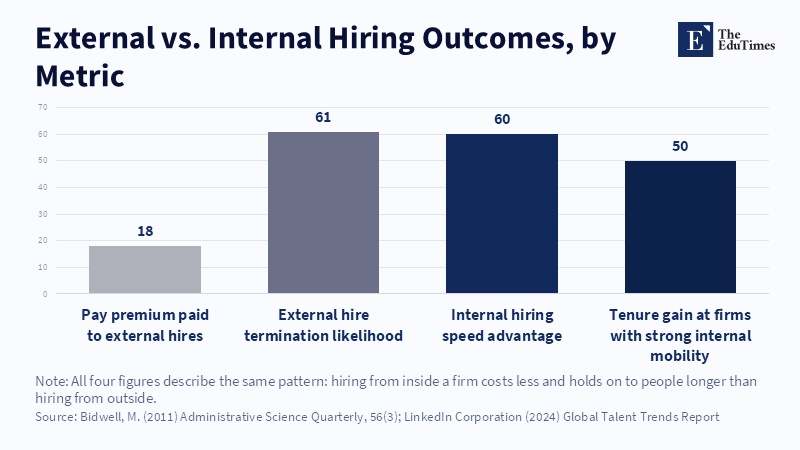
Company-specific training widens this gap the longer an employee stays. An employee who already knows the company's tools, customers and internal habits costs much less to stay useful than a new employee who first has to learn all three. Once a company has spent months training someone, losing that person rarely feels like a small decision for the manager who approved the training budget. LinkedIn mobility data shows that companies with strong internal movement retain staff for periods of more than 50 percent longer than companies that pre-select external hires. About one-third of employers now say they plan to shift their hiring effort to internal roles rather than external ones next year. For a graduate standing outside the company, none of this depends on credentials at all. The company doesn't weigh a philosophy degree against a coding bootcamp certificate. It weighs a familiar insider against an unknown outsider. The insider tends to win.
The Entry-Level Door Is Closing for Everyone
This pattern is clearly seen in the data on young graduates. It complicates any story that treats skills-based hiring as just good news for young workers who don't have a degree. The Federal Reserve Bank of New York is keeping a close eye on this. Its most recent data places unemployment for college graduates aged 22 to 27 at about 5.6 percent by the second quarter of 2026. Underemployment for the same group is close to 42 percent. This unemployment rate is now above the rate for the labor force, which was just the case between 1990 and about 2018. Entry-level job postings have fallen by double-digit numbers year-over-year on major hiring platforms. Applications per post have risen sharply by the same extent. Fewer open roles are now being pursued by more people on both sides of the degree line. Part of this squeeze is found in AI taking on routine tasks. More than a third of entry-level posts now list some AI capability as a requirement, nearly three times the share recorded at the end of 2025, according to NACE itself's tracking.
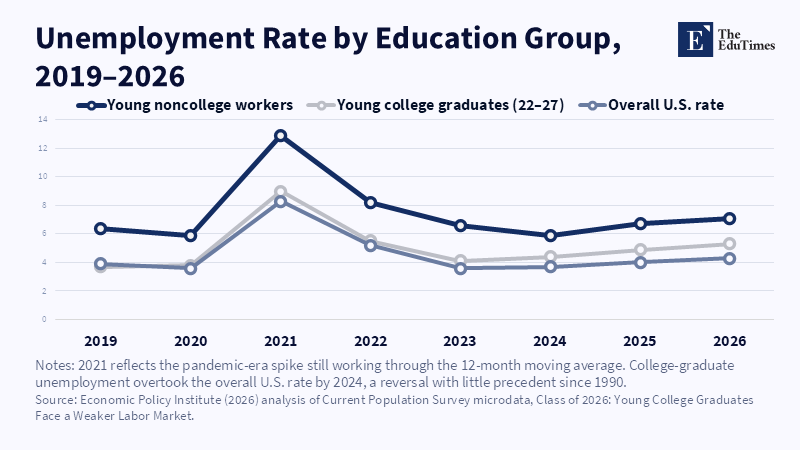
If skill-based hiring simply swapped one filter for another, something should show up in the data. Unemployment among skilled but non-skilled workers should have improved as unemployment among degree holders worsened. It didn't work so cleanly. Young workers without a college degree also saw their own unemployment rate rise over the same period, up about 1.2 percentage points from the beginning of 2024. What initially looks like a credentials story turns out to be closer to a story about hiring volume. Companies aren't just choosing skills over entry-level degrees. Many choose not to hire from outside at all because internal training and internal retention cost less. The power of the university is not fading mainly because employers have found a sharper filter for talent. It is fading because the door that graduates are trying to get through has narrowed for almost everyone standing in front of it, regardless of the papers they happen to be carrying.
What This Means for Universities, Employers and Policymakers
University leaders shouldn't read this as a call to rebrand curricula as short courses or bootcamps. That answer chases the wrong number. Career services agencies are best served by treating internal mobility, not the open job posting, as the actual hiring channel that matters. This means creating direct lawsuits through internships and apprenticeship-to-hire programs, where companies are already showing that they will invest in people they can track and test over time. Employers have their own gap to close. TestGorilla's adoption numbers and the Burning Glass Institute's hiring results data describe two different companies. One talks about skill-based recruitment. The other practices it. Closing this gap requires real changes to applicant tracking software and interview planning, not just deleting a line from a job posting. The Society for Human Resource Management's own benchmarking places the average cost of a single external hire close to $4,700, an amount worth putting in front of any executive who still assumes that external hiring is the cheapest option once the time to raise is added. Policymakers weighing credential reform should treat the slowdown in entry-level hiring as a labor demand problem first and then as a certification problem. Broadening who is eligible to apply changes little if companies don't expand how many outsiders they hire in the first place.
Skeptics will point to companies like IBM and Walmart, which have posted real, measurable movement in the share of non-degree hiring, as proof that this change is genuine. That's a fair point, as far as it goes. These companies remain the exception invoked by the Burning Glass Institute itself. They are not proof that the exception is becoming the norm across the broader economy. Even LinkedIn's own research, often cited to support the skills-based hypothesis, finds that skill-based matching can increase a pool of candidates by up to ten times without any corresponding increase in actual hiring. Team size and hiring behavior count two different things. Increasing who can apply for a role is not the same as increasing who is offered to them. Treating these two numbers as interchangeable is where most of today's optimism about skills-based hiring is quietly collapsing.
Eleven thousand three hundred companies actually experimented. They tested whether removing the degree requirement would change who they hired. For most of them, it didn't. This unique finding should reset the terms of the argument with which this piece began. Universities don't lose their power because employers suddenly discovered that skills matter more than diplomas. Most employers already believed this, in principle and continued to hire in the same way independently. Skills-based recruitment, as a phrase, described a struggle over which filter should decide who gets through the door. The real story of 2026 is that fewer companies want to open the door to outsiders in the first place, no matter what filter they use. What has really changed is something else: companies' willingness to hire outside their walls. This retreat falls almost equally on bootcamp graduates and degree holders. Institutions that want to stay relevant should stop competing to prove that their graduates are more proficient on paper. They should start competing to bring these graduates early to a company's doors, through internships, apprenticeships and employer partnerships that turn an outside candidate into a well-known insider before the hiring decision is ever made.
This article reflects the analytical judgment of The EduTimes Editorial Board and does not constitute policy advice or the official position of any affiliated institution.
References
Bidwell, M. (2011) 'Paying more to get less: the effects of external recruitment versus internal mobility', Administrative Science Quarterly, 56(3), pp. 369-407.
Federal Reserve Bank of New York (2026) The Labor Market for Recent College Graduates. New York: Federal Reserve Bank of New York.
LinkedIn Corporation (2024) Global Talent Trends Report. Sunnyvale, California: LinkedIn Corporation.
LinkedIn Corporation (2024) Economic Graph Research: Skills-Based Hiring and Candidate Pools. Sunnyvale, California: LinkedIn Corporation.
National Association of Colleges and Employers (2026) Job Outlook 2026. Bethlehem, PA: National Association of Colleges and Employers.
Sigelman, M., Fuller, J.B. and Martin, A. (2024) Skills-Based Hiring: The Long Road from Pronouncements to Practice. Boston, MA: Burning Glass Institute and Harvard Business School Managing the Future of Work Project.
Society for Human Resource Management (2025) Human Capital Benchmarking Report: Cost per Hire. Alexandria, Virginia: Society for Human Resource Management.
TestGorilla (2025) State of Skills-Based Hiring 2025. Amsterdam: TestGorilla.