Cognitive Internalization: The New AI Policy In Universities

Input
Modified
Cognitive internalization replaces policing as the new AI policy
Age, not ability, predicts AI dependence and thinking loss
Course design, not student rules, should absorb responsibility

Students aged seventeen to twenty-five have, according to a recent study, a higher reliance on AI tools and lower critical thinking performance than adults over forty-six, who rely much less on the same tools. This difference does not prove that the younger generation thinks worse than the older generation. It proves that the age at which someone encounters a powerful tool determines how easily they delegate their thinking to it. Universities, instead of treating this finding as a problem of course design, still treat it as a problem of student discipline, writing rules about what is allowed and what is not, while the real issue is how the very work that the student is asked to deliver is designed.
Why AI Rules Are Repeating the Mistakes of Plagiarism Policy
The reaction of universities to artificial intelligence repeats, almost word for word, the history of plagiarism. For a decade, students who wrote in a second language were reported to disciplinary boards instead of being taught, even though research showed that copying with slight modifications is a developmental stage of almost every novice writer. Özgür Çelik describes how AI rules are now reproducing the same mistake: they moralize a learning issue, feign neutrality in rules that in practice favor the native speaker and again trust machines that prove unreliable, only now with worse evidence than before.
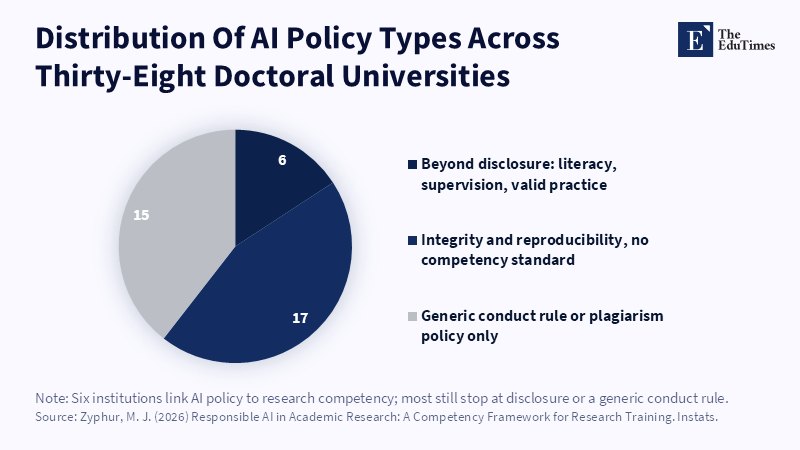
At the level of research, the picture is no different. Michael Zyphur's study of thirty-eight leading doctoral universities in fifteen countries found that only six institutions had developed policies beyond superficial disclosure of use, while fifteen remained at the level of a general rule of conduct and seventeen had touched on reproducibility issues without codified expectations of ability. The conclusion of both texts converges on one point: as long as policy focuses on whether an act is permitted or prohibited, it ignores the question that really counts, namely whether the student or researcher actually edited what the tool produced before signing it as their own.
There is a significant difference between students and the institutions that teach them. The student uses a tool that he did not design himself, in a course that he did not design, with rules that he did not write himself. He is a consumer of a technology, not its producer. The responsibility for the consequences of a new technology on society and learning belongs in the first instance to those who produce it and to those who design the framework in which it is used, not to its end user. A policy that punishes the student for behavior that the educational system itself was not prepared to manage shifts to the wrong side a responsibility that does not belong to it.
When AI Use Starts to Replace Critical Thinking
A study by SBS Swiss Business School's Center for Strategic Corporate Prediction and Sustainability, published in the journal Societies, examined the relationship between frequent use of AI tools and critical thinking. It found a strong negative correlation between the two variables, with cognitive offloading, i.e., transferring mental effort to an external tool, acting as the strongest predictor of reduced critical engagement. Younger participants, aged seventeen to twenty-five, showed higher dependency and lower thinking performance, while older participants, aged forty-six and over, showed the reverse pattern. Education level acted as a protective factor, almost regardless of the degree of AI use. Gender showed no significant effect on participation in deep thinking activities, which weakens explanations that attribute the difference to factors beyond age and education.
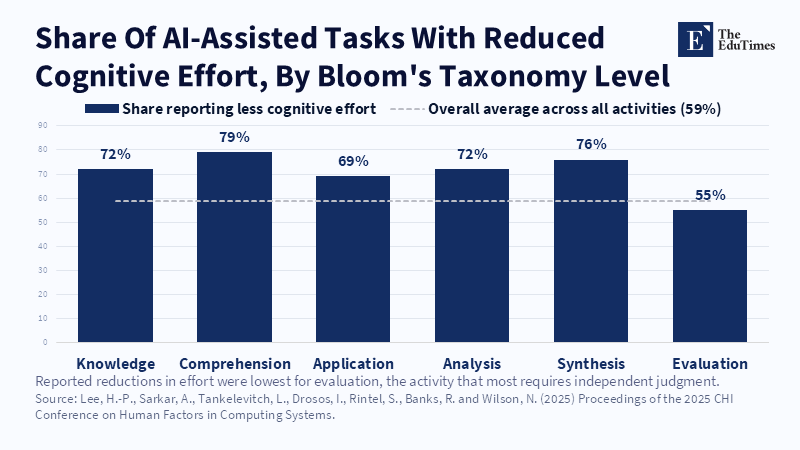
A similar pattern was found in three hundred and nineteen knowledge workers, with nine hundred and thirty-six recorded incidents of using generative AI in real work. Critical thinking was activated in about six out of ten cases, with the most critical finding being the following: the more confidence someone had in the ability of artificial intelligence, the less critical thinking they triggered, while trust in personal judgment had exactly the opposite effect. This finding shifts the burden from the tool itself to how the user relates to it, something that no prohibition policy alone can regulate.
The study itself in Societies captures what deep thinking means, in practice: prolonged reading of complex texts, writing that requires formulation and elaboration of complex ideas, problem-based learning that applies knowledge to new situations. None of these activities excludes the use of artificial intelligence. It only excludes its use as a substitute for thinking itself.
The same research also found that the relationship between the use of artificial intelligence and critical thinking is not linear. Moderate use seems to be managed without significant negative effects, while beyond a certain level the negative effect accelerates. This finding removes the ground from two opposing simplifications: neither a complete ban is necessary, nor unrestricted use is harmless. The question that every course has to answer is not whether artificial intelligence is allowed, but at what point in the work its use begins to replace, rather than support, the student's thinking.
Why Course Design Matters More Than Detection
The uncertainty surrounding AI rules is not limited to large research institutions. Universities at the local level, such as those in the Pittsburgh area, still haven't finalized their own policies and the speed at which the tools evolve is outpacing the pace at which the rules are written. The University of Pittsburgh, notably, disabled the AI detection tool within the Turnitin system, judging that it was not accurate enough to support accusations of academic integrity violations. This move shows a shift in perception that goes beyond one institution: from controlling student behavior to designing the course itself.
This shift is what the concept of cognitive internalization describes. Instead of prohibiting the use of artificial intelligence, the course is designed so that the student cannot simply deliver the tool's product as a final answer. They are asked to evaluate it, question it and explain orally or in writing why he kept one sentence and rejected another. The student remains a consumer of the technology, not its producer. The responsibility for how this technology is introduced into the classroom lies with those who design the course and the tools, not with those who simply use them every day without having made them.
This shift is not only a pedagogical choice; it is also a matter of fair sharing of responsibility. When an institution equips itself with a detector instead of reshaping its work, it shifts to the student the cost of a technological change that it did not cause. The same pattern was found in plagiarism, where second language students disproportionately shouldered the burden of a control system designed around the native speaker's experience. Changing perspective, from behavior control to system design, corrects both problems at the same time: it reduces unfair accusations and enhances learning itself.
What Cognitive Internalization Means in the Classroom
For teachers, change requires tasks with intermediate stages: outline, draft, revision with documentation of the changes, oral discussion of the arguments. None of these forms of assessment need detection software, because the process itself reveals whether there has been substantial editing by the student. For administrators, it means training professors in designing such tasks, not just in using a new software tool. The American Psychological Association itself points out that there is already clear evidence that humans perform many tasks better with the help of artificial intelligence; the question that remains open is what happens to their skills later, when the tool is no longer available. The same source notes that the structured use of artificial intelligence, i.e., use within a defined framework of roles and boundaries, can optimize human-machine collaboration without sacrificing human capabilities. It is precisely this structure that cognitive internalization is trying to introduce into the classroom: not prohibition, but roles.
An expected objection is that designing assignments around cognitive internalization takes more time than professors who are already burdened with large departments and that this model hardly scales up to courses of hundreds of students. The objection has real basis, but the same evidence shows that the alternative, i.e., investing in detectors, does not save time; it simply shifts time from lesson planning to handling false accusations and student appeals. The level of education, as the study in Societies showed, already acts as a protective factor against cognitive discharge, which means that investing in better pedagogical design already has a measurable benefit, regardless of how often the student ends up using AI outside the classroom.
The role of the lecturer, in this context, is no longer to catch the student in the act. It is to design a project where taking a shortcut no longer works, because the issue is not the final text but the ability to defend it. Universities that have already begun to reformulate work in this direction report fewer conflicts between students and professors, precisely because the issue of trust is no longer at the center of any evaluation.
The same five-dimensional framework that Zyphur proposed for research education includes a corresponding separation: work that AI can speed up with control, such as formatting or first organizing a text and judgment that must remain human, such as choosing a method or interpreting an unexpected result. The same distinction, carried over to the undergraduate classroom, gives teachers a specific design criterion: each assignment must explicitly state which parts can be done with the help of a tool and which parts should remain exclusive to the student.
The difference between seventeen-to twenty-five-year-old students and adults over forty-six is not biological. It is the imprint of an educational system that has not yet designed ways for thinking to remain with the student. Policing the use of artificial intelligence, as the experience with plagiarism has shown, does not correct this gap; it simply shifts it to the next generation of rules. Cognitive internalization offers an alternative that does not need detection software, only tasks designed so that the final text is not sufficient on its own. The institutions that will shift their attention from student control to course design will be the ones that shape the next chapter of educational policy, rather than writing it after the fact, when the problem has already grown.
This article reflects the analytical judgment of The EduTimes Editorial Board and does not constitute policy advice or the official position of any affiliated institution.
References
Abrams, Z. (2026) 'How AI is reshaping human skills and thinking', Monitor on Psychology, 57(5).
Çelik, Ö. (2026) 'AI policies are repeating every mistake of plagiarism policies', Times Higher Education, 28 August.
Gerlich, M. (2025) 'AI tools in society: impacts on cognitive offloading and the future of critical thinking', Societies, 15(1), p. 6.
Lee, H.-P., Sarkar, A., Tankelevitch, L., Drosos, I., Rintel, S., Banks, R. and Wilson, N. (2025) 'The impact of generative AI on critical thinking: self-reported reductions in cognitive effort and confidence effects from a survey of knowledge workers', in Proceedings of the 2025 CHI Conference on Human Factors in Computing Systems. New York: ACM, pp. 1-22.
Trinka AI (2026) University of Pittsburgh AI Policy. AI Policy Repository.
Zyphur, M. J. (2026a) Responsible AI in Academic Research: A Competency Framework for Research Training. Instats.
Zyphur, M. J. (2026b) 'Universities must look beyond plagiarism to govern AI research', University World News, 25 August.