AI in Higher Education: Why Universities Must Redesign Learning

Input
Modified
Student AI use is already the baseline
Institutional policy and staff capability still lag
Better assessment design turns AI into learning

The share of UK undergraduates who told the Higher Education Policy Institute they used generative AI this year was at 95 percent, up from 66 percent just two years earlier. Numbers like that don't leave much room for debate about whether AI in higher education is a passing trend. It isn't. It's the new baseline and universities that are still arguing about whether to allow it are arguing about something that already happened. The real argument, the one worth having, is about what students are doing with these tools once they open them. Right now, most are using AI in higher education the way they'd use a faster search bar or a tireless copy editor. Far fewer are using it for difficult conceptual work or deeper learning. That gap between adoption and actual learning is where policy needs to go to work and it's where most institutions still have nothing to say.
The Numbers Have Already Made the Decision
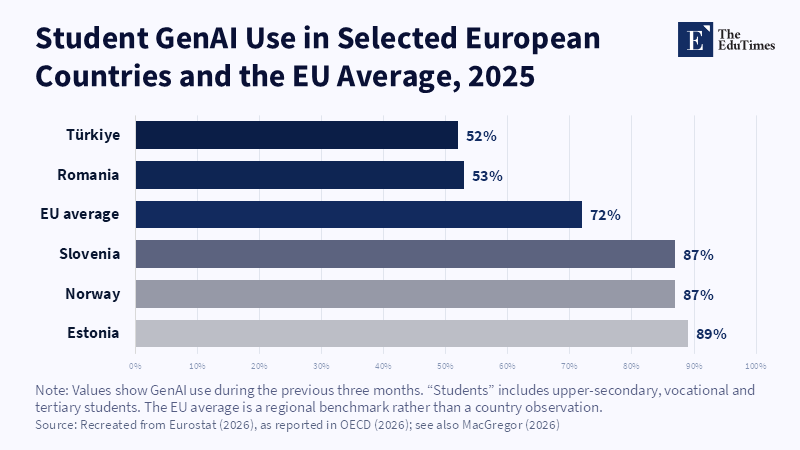
Look past the UK figure and the pattern holds. A 2024 survey spanning sixteen countries found 86 percent of higher education students using generative AI in their studies. Across the European Union, the average in 2025 sat at 72 percent, though the range beneath that average tells its own story: 89 percent of students in Estonia, 87 percent in Norway and Slovenia, against just 53 percent in Romania and 52 percent in Turkiye. Staff have moved more slowly but they've moved. The Digital Education Council found 61 percent of academic staff across 28 countries using AI weekly in 2025 and in Australia three-quarters of academics were already using it for their work by the middle of 2024. Widen the lens to include administrative and support staff and the number in Canada and the United States hit 84 percent in 2024, more than double the 41 percent recorded the year before.
None of this is close to uniform. Surveys out of Germany and Britain show STEM and business students and staff reaching for AI far more than colleagues in the arts and humanities. German research found usage at 69 percent among men versus 60 percent among women, a gap researchers link to prior exposure and comfort with the technology rather than access, since the tools themselves are free. What's consistent across nearly every dataset is depth or the lack of it. Just 17 percent of academics worldwide describe themselves as advanced or expert AI users. Among the faculty who do use AI in their teaching, 88 percent say they use it only minimally or moderately. Students, for their part, gravitate toward summarising, editing and translating. Quick tasks. Low-stakes tasks. Not the kind of engagement that builds understanding.
That combination, near-total adoption paired with shallow use, is the actual crisis, not the one most headlines describe. It's not that students are using AI in higher education too much. It's that they're using it too narrowly and institutions have offered almost no direction on what a fuller, more demanding use might look like.
A Tool for Speed, Not for Understanding
Here's a detail that should worry anyone still picturing GenAI as some kind of shortcut to deep learning: in 2025, American students were less likely to turn to AI for difficult academic tasks or conceptual questions than they had been the year before. Faced with something genuinely hard, they went back to asking their instructors. That's not an accident and it's not a flaw in the students. It's what these tools were built to do. General-purpose AI systems generate outputs. They don't carry any pedagogical intent. A chatbot can hand a student a finished paragraph, but it does nothing to make sure that student understands why the paragraph says what it says. A review of the cognitive effects of ChatGPT in higher education, published this year, reached a similar conclusion: AI can support certain kinds of creative work, but the evidence for improvements in deeper critical thinking is mixed at best and several studies point to real risk of over-reliance and surface-level engagement.
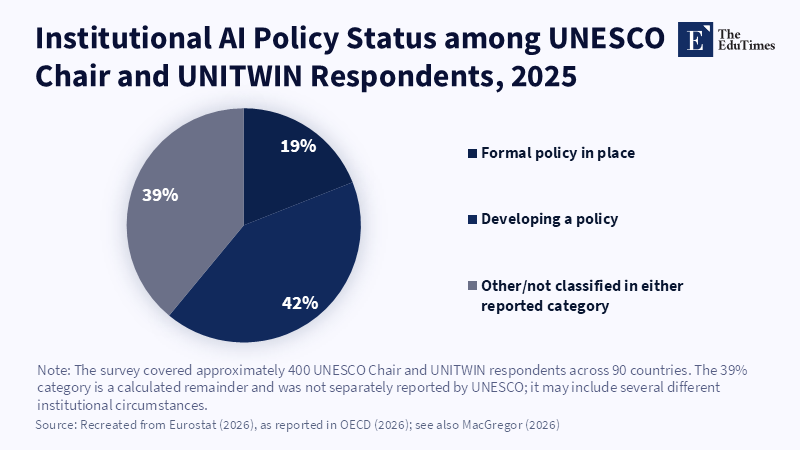
Layer institutional silence on top of that pattern and you get a fairly bleak picture. A 2025 UNESCO survey of approximately 400 UNESCO Chair and UNITWIN respondents across 90 countries found that 19 percent had a formal AI policy in place, while another 42 percent were developing one. Progress varies wildly by region. In the UK this year, researchers could find publicly posted policies at just 96 of 163 institutions they checked. Coursera's research adds the missing piece: globally, only 25 percent of faculty feel they have the skills to use AI effectively and just 28 percent believe their institution has prepared them to manage how students use it. Left without guidance, people improvise. Responsibility for data protection, academic integrity and ethical use falls onto individual students and individual instructors, one inbox at a time. That's not a policy, that's an absence dressed up as neutrality.
Access compounds the problem. Free consumer tools dominate: ChatGPT, Grammarly and Microsoft Copilot top the list of what students actually use, according to the Digital Education Council's global survey. Only 38 percent of UK institutions provide any AI tools to students directly and in Germany the figure sits closer to 30 percent of universities holding any GenAI licenses at all. So students are left buying their own subscriptions or making do with free tiers, entering coursework and personal data into systems whose terms of service were never written with a classroom in mind.
What Actual Redesign Looks Like
An OECD paper on future skills makes an important point that education planning should stop treating AI as an exception to work around and start treating it as a fixed feature of how students will learn, full stop. That reframes the whole assignment. If a tool is going to be present no matter what a syllabus says, banning it doesn't remove the tool. It just removes the university's ability to shape how it gets used.
Think about how coding education handled a nearly identical problem twenty years ago. Students could always find sample code in a manual or lift a working snippet from a forum. That was never the issue. Copying code off Stack Overflow doesn't solve anything on its own; the code still has to run, still has to fit the actual problem, still has to be debugged when it breaks in some way the manual never anticipated. A student staring at a failing test case has to understand what the code is doing, whether they wanted to or not. The task forced comprehension, even when the starting material was borrowed.
That's the model worth copying now. Assignments can be built so that each question depends on the one before it, referencing material only the instructor has modified, so a generic AI answer to question two doesn't fit the specific version of question three. Ask students to submit not just an answer but a short account of where the AI's first attempt was wrong and how they fixed it. Grade the revision, not the draft. None of this requires banning anything. It requires professors to stop writing assignments that a chatbot can finish in one pass and start writing ones that only get finished through iteration, judgment and reference back to what was actually taught in class. Students end up owning the outcome because the shortcut simply doesn't lead anywhere on its own.
Take a first-year statistics course as another example. A generic prompt like "explain a t-test" gets a competent, generic answer from almost any chatbot and that answer teaches the student very little because it was never built around their specific dataset or their specific error. Now change the assignment. Give each student a dataset the instructor collected or modified this term, one AI has never seen in training and ask them to diagnose why their result contradicts the textbook example. The AI can still help them get there. It can suggest which test to run, explain what a p-value means, point out a coding mistake in their script. But it can't hand them the diagnosis outright, because the diagnosis depends on their specific numbers and the specific twist the instructor built in. That's the difference between AI as an answer machine and AI as a tutor a student has to interrogate. The tool is the same. The task around it decides everything.
This kind of redesign takes real time up front and it's worth saying plainly that most departments aren't resourcing it. Writing a chain of interdependent questions, each one referencing customized course material, takes longer than writing a single essay prompt that's been recycled for a decade. Professors juggling research quotas and oversized sections have little incentive to take that on alone, especially with no institutional recognition for the extra hours. That's exactly why this can't stay a matter of individual goodwill. Without support, workload relief or shared templates, the redesign will stay confined to the handful of instructors who happen to care enough to build it from scratch, while everyone else keeps assigning work a chatbot finishes in ten seconds flat.
From One Lecture Hall to a Ministry
A single professor doing this well helps one class of thirty or a hundred. Useful, but small. Scale the same logic to a curriculum committee or better, to a ministry of education and the equation changes. Korea already gestures at this: this year it designated twenty universities to build a shared foundational AI curriculum, with government funding attached to staff training and materials that get distributed sector-wide rather than reinvented at every campus. France has multiple universities co-developing tools with outside partners rather than leaving each department to sort out its own approach. Neither example is a finished model. Both point at the same idea: when redesigned, AI-resistant assessment gets built and tested at a national or system level, the lessons don't stay trapped in one professor's gradebook. They become shared infrastructure, the same way a shared textbook or a shared exam standard becomes infrastructure.
That's the real policy opportunity sitting underneath all these adoption numbers. It has almost nothing to do with detection software or honor codes and almost everything to do with whether the people writing curricula understand that AI in higher education is now a permanent condition of student work, not a threat perimeter to defend. The instructors already reworking their assignments around this reality are doing the hard, granular work of figuring out what actually holds up against a chatbot. What's missing is the mechanism to take what they learn and hand it to everyone else. Ninety-five percent of students didn't wait for that mechanism to show up. Neither should the people setting policy.
The views expressed in this article are those of the author(s) and do not necessarily reflect the official position of The EduTimes or its affiliates.
References
Coursera (2026) Coursera Campus Skills Report 2025. Mountain View, CA: Coursera Inc.
Digital Education Council (2024) Global AI Faculty Survey 2024. Zurich: Digital Education Council.
Eurostat (2026) Digital Skills and AI Use in Tertiary Education, 2025 Data Collection. Luxembourg: Publications Office of the European Union.
Higher Education Policy Institute (2026) Student Generative AI Survey 2026. Oxford: HEPI.
Li, X., Cui, Y. and Hagedorn, A. (2026) 'A systematic review of the cognitive effects of ChatGPT use in higher education', Journal of Computer Assisted Learning, advance online publication.
MacGregor, K. (2026) 'New OECD report explores AI in HE, emerging evidence', University World News, 24 July.
OECD (2025) What Should Teachers Teach and Students Learn in a Future of Powerful AI? OECD Education Spotlights, No. 20. Paris: OECD Publishing.
OECD (2026) Policies Supporting Responsible and Systematic GenAI Adoption in Higher Education. OECD Education Spotlights, No. 23. Paris: OECD Publishing.
UNESCO (2025) Global Survey on AI Governance in Higher Education Institutions. Paris: UNESCO.