Why Teaching Incentives Keep Failing: What Would Actually Fix Them

Input
Modified
Teaching skill rarely decides pay or promotion
Coaching-linked pay works; flat schedules don't
Reward performance, not tenure or credentials

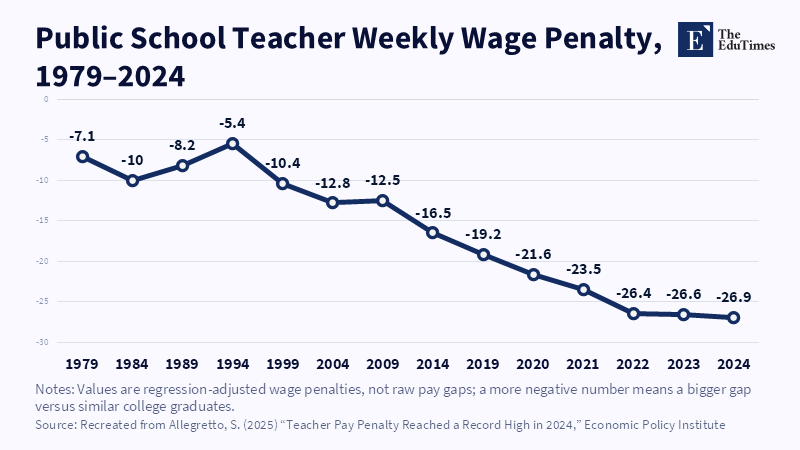
In 2024, the average American teacher earned 26.9 cents less on every dollar paid to a worker with the same education in another field. That gap has never been wider. The Economic Policy Institute has tracked it for almost three decades. It sits near the center of the argument about why teaching quality lags. But it rarely gets treated as the actual center. Most conversations about weak teaching point to training gaps: not enough coursework, thin mentorship, a missing summer workshop. Training matters. But training only pays off if the system around it rewards the skill it produces. And in nearly every corner of education, from the university lecture hall to the fifth-grade classroom, teaching skill barely moves pay, promotion or job security. Some call the absence of teaching preparation the profession's quiet scandal. The bigger problem sits past preparation. Even where teaching skill exists, almost nothing in the system rewards it.
Where Teaching Incentives Break Down in the Academy
Graduate students who win university-wide teaching awards often learn a hard lesson on the job market: nobody asks about it. A 2020 survey looked at 317 early-career researchers. It ran in the journal eLife. It found teaching experience carried no real link to job offers. Search committees weighted publication counts, citation totals and co-authorship on prestigious papers instead. A separate study of hiring in public affairs doctoral programs found something similar. Teaching statements and prior TA experience ranked near the bottom of what committees valued. Teaching awards and conference papers landed at the very bottom. Faculty learn this quickly, usually within a year of arriving. A semester spent redesigning a syllabus counts for far less at review time than one paper in the right journal. It reflects an incentive structure working as designed, just not for the purpose universities publicly claim.
The imbalance goes back further than any single hiring cycle. Doctoral programs are built almost entirely around research output. Dissertations, publications, grant applications, conference presentations: these define the years of a PhD. Teacher training, where it exists at all, is often one orientation session lasting a few hours. Universities have spent decades building systems for research. Ethics boards. Grant offices. Peer review panels. Structured training in research methods. Teaching development has stayed voluntary and informal by comparison. A professor can teach brilliantly for twenty years and see almost none of it reflected in a tenure file. An average lecturer with three strong papers advances without friction. Ask which folder a search committee opens first. It's rarely the teaching portfolio.
This is not an argument that research should matter less. Research funding, peer review and rigorous methods training exist because knowledge production genuinely needs them. The point is narrower. Universities built serious professional systems for one core duty. They left the other duty to learning on the job, with no real guide and no formal check. No comparable profession certifies people this loosely for its central task. A new surgeon does not learn technique by trial and error on live patients; a new pilot does not learn to land by trial and error with passengers aboard. Universities have run teaching this way for decades.
The Same Incentive Problem in K-12 Classrooms
Move from the professoriate down to primary and secondary schools. The setting looks nothing alike. But the shape of the problem barely changes. Most public school teachers in the United States sit on a single salary schedule. Pay is tied to years of service and academic credentials, not classroom effectiveness. A teacher who transforms outcomes for an entire cohort earns the same annual raise as a colleague who coasts. The wage penalty adds to that flatness. Public school teacher pay now sits 26.9 percent below similar workers with the same education, per the Economic Policy Institute's latest figures. That is the widest gap the group has recorded since it began tracking the number in 1996.
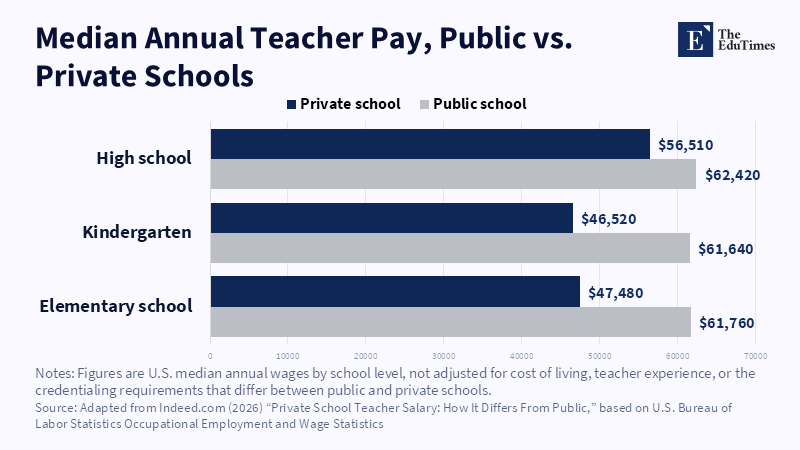
Private schools, despite running closer to a market model, pay even less. Bureau of Labor Statistics data show median pay for public elementary teachers at $61,760 a year. Private elementary teachers earn $47,480. That comparison complicates any tidy story about markets automatically rewarding skill. Private schools compete on tuition and mission, not teaching quality. They end up paying worse, not better, with fewer union protections to soften the blow.
Merit pay experiments have tried to close this gap directly. The results are more encouraging than the policy's reputation suggests. A 2017 review from Vanderbilt's Peabody College looked at 44 studies of teacher merit pay. It found a small but real rise in student achievement. The size was roughly equal to four and a half extra weeks of learning. The effect grew larger when bonuses came bundled with coaching, not cash alone. A 2023 study from the National Bureau of Economic Research followed South Carolina students who had attended schools using the Teacher Advancement Program. That model pairs bonuses with regular observation and feedback. Years later, those students were more likely to graduate on time. They were less likely to face felony charges. They were less likely to depend on public assistance in early adulthood. The year-to-year test-score gains were small but they compounded into something durable across a childhood. None of this proves cash alone fixes teaching. It shows that pay tied to performance, built with structure and follow-through, moves outcomes a flat salary schedule simply cannot reach.
Why Public Systems Resist Teaching Incentives
Given that evidence, the persistence of flat pay scales looks less like an oversight and more like a quiet preference. Public teaching jobs offer something the private sector rarely matches. Job security is almost total. The salary ladder is predictable. The pension asks for no investment decisions. That combination draws people who value steadiness over performance-based reward. It is a pattern. It grows stronger with every new hire. It also explains a half-joking line that circulates among teachers themselves. Education may be the one skilled field where the public sector pays worse than the private sector. Yet the public side still draws more applicants for its steadiest jobs. People are trading income for security. The system makes that trade easy.
Several countries have gone further and nationalized teacher training outright. The hope was that a single standardized pipeline would guarantee a consistent floor of quality. The logic reads well on paper: run every teacher through the same coursework, apply the same national standards and quality is expected. In practice, a monopoly on training removes the pressure that normally forces a pipeline to keep improving. There are no rival programs competing for students. There is no real threat of losing enrollment to a better alternative. National teacher-training systems tend to freeze in place once the first standards are set. Reform then depends on political will, not real competition. Political will moves slowly and a workforce this large needs quicker correction.
These nationalized systems were built to fix inconsistent, undertrained teaching. They solved it by removing the mechanism that normally punishes stagnation, instead of building one that rewards improvement. A national training board answers to a ministry, not to students choosing where to enroll or families choosing where to pay tuition. When quality slips, there is no competitor waiting to absorb the demand and force a correction. The system absorbs the slippage instead of correcting it.
Building Teaching Incentives That Actually Work
None of this argues for importing private-sector logic wholesale. The objections to that idea deserve to be taken seriously, not waved off. Critics of merit pay note, correctly, that narrow test-score bonuses can push teachers to drill for exams instead of teaching well. They also note that ranking teachers against each other can damage the collaboration good schools depend on. Those risks are legitimate. But the Teacher Advancement Program results point to a way around them. Bundle incentives together with observation and coaching. Use several measures of performance rather than a single test score. Do that and the bad side effects shrink while the real benefits hold. The same principle applies above K-12. If universities want teaching skill to matter, tenure and promotion committees need to weigh teaching evidence. Peer observation. Course redesign. Documented gains in student learning. These need something close to the seriousness already given to citation counts. A teaching portfolio nobody reads shows what the reward structure was actually built to measure.
For decision-makers, the fix is not another summer training module bolted onto an unchanged system. It is changing what gets measured and paid for. State salary schedules built purely on tenure need room for something else. Pay should track several measures of performance, not just one test score. It should come paired with ongoing coaching, the kind that turned the South Carolina program's effects from a short-term blip into a decade-long trend. Accreditation bodies overseeing teacher-training programs should be evaluated and funded partly on the outcomes their graduates produce. A program's survival should depend on preparing effective teachers, not just enrolling students. University hiring and promotion committees should require documented teaching evidence with roughly the rigor already applied to a publication list. None of this requires dismantling public education or handing schools to private operators. It requires the public system to borrow the one thing functioning markets do reliably. Tie reward to demonstrated performance. Don't tie it to tenure, title or good intentions alone.
The 26.9-cent gap isn't just a wage statistic. It shows up at every level of the system: what earns reward and what doesn't. Skilled teaching, whether it happens in a professor's seminar room or a fifth-grade classroom, competes for institutional attention against research output, seniority and job security and usually loses. Decades of merit-pay studies, hiring surveys and compensation data converge on the same point. Schools and universities are not short on evidence about what improves teaching. They are short on a reward system built to act on that evidence. Closing the gap will take more than another training requirement layered onto an incentive structure nobody has touched. It will take pay scales, promotion criteria and accreditation rules that actually track performance. Until that changes, skipping teacher training will keep carrying no real cost.
This article reflects the analytical judgment of The EduTimes Editorial Board and does not constitute policy advice or the official position of any affiliated institution.
References
Allegretto, S. (2025) The Teacher Pay Penalty Reached a Record High in 2024: Three Decades of Leaving Public School Teachers Behind. Washington, DC: Economic Policy Institute and Center for Economic and Policy Research.
Bureau of Labor Statistics (2026) Occupational Employment and Wage Statistics: Elementary and Kindergarten School Teachers. Washington, DC: United States Department of Labor.
Cohodes, S., Eren, O. and Ozturk, O. (2023) The Long Run Effects of a Comprehensive Teacher Performance Pay Program on Student Outcomes. NBER Working Paper No. 31056. Cambridge, MA: National Bureau of Economic Research.
Fernandes, J.D., Sarabipour, S., Smith, C.T., Niemi, N.M., Jadavji, N.M., Kozik, A.J., Holehouse, A.S., Pejaver, V., Symmons, O., Bisson Filho, A.W. and Haage, A. (2020) 'A survey-based analysis of the academic job market', eLife, 9, e54097.
Pham, L.D., Nguyen, T.D. and Springer, M.G. (2017) Teacher Merit Pay and Student Test Scores: A Meta-Analysis. Nashville, TN: Vanderbilt University, Peabody College, National Center on Performance Incentives.