The Publication Count Is Broken: Why AI-Generated Academic Papers Demand New Metrics

Input
Modified
AI now writes a fifth of research papers
Paper mills concentrate in a few weak-review journals
Accreditation must weight citation impact over raw volume

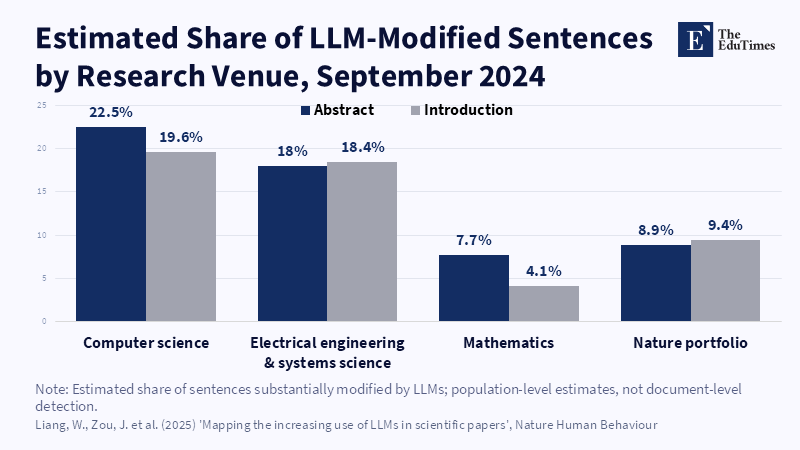
By late 2024, roughly one in five computer science papers carried the fingerprints of a chatbot. Stanford researchers scanned more than a million abstracts and found that 22.5 percent showed clear signs of large-language-model editing. In biomedicine, the share sat near one in seven. This is the daily output of a global research system that governments, universities and accreditation boards still measure by counting pages. AI-generated academic papers moved from novelty to norm in a few short years, faster than the institutions that judge research quality could keep up. The count-based systems built for a slower, more effortful era of scholarship need a full rebuild, not a patch before volume metrics lose whatever meaning is left in them.
The Productivity Boost Nobody Wants to Admit
Agentic writing tools do something a research assistant rarely manages: they compress months of drafting into days. Cornell's Yian Yin and Stanford's James Zou led a 2025 analysis in Science that tracked more than two million preprint abstracts and found that authors who had adopted large language models grew significantly more productive once the tools became available. Many researchers already sensed as much. Once a strong research question is identified, it can now be built into a full manuscript with far less manual labor and a person still does the thinking, even as a machine handles much of the typing, formatting and literature summarizing.
The scale keeps growing. Andrew Gray at University College London estimated that at least one percent of papers published in 2023, more than 60,000 manuscripts, were written at least partly by AI, based on sudden spikes in words like "meticulously" and "intricate." A separate study from the University of Tübingen, led by Dmitry Kobak, scanned fifteen million biomedical abstracts on PubMed and found the AI-influenced share climbing to roughly one in seven by 2024. The publisher of the American Association for Cancer Research journals found AI-generated text in nearly 15 percent of methods sections and 7 percent of peer-review reports by the final quarter of that year. These numbers, added up, describe a lasting shift in how papers get made, one that a publication-count system built for the old way of working was never designed to register.
When Formality Beats Substance in the Lower Tiers
AI writing faster is not the real issue. The trouble starts when a journal only checks whether a manuscript looks like a paper, rather than whether its reasoning holds up. One widely discussed case saw a manuscript built substantially by AI tools pass peer review at a respectable outlet, its formatting and citations intact but its original contribution thin. Multiply that case across thousands of lower-tier journals that lean on checklists instead of close reading and a real problem takes shape. Journals that verify structure but not substance are close to perfect targets for AI-assisted volume production.
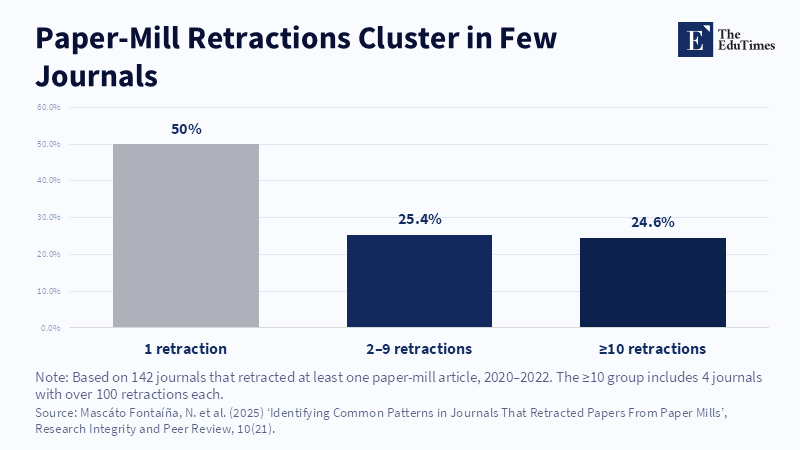
Retraction data backs this up. More than 10,000 papers were pulled from the scientific record in 2023, a new annual record, with retractions rising faster than publication itself. Paper mills, the fraudulent operations that manufacture and sell fake authorship slots, accounted for a large share of that spike. Hindawi alone retracted more than 8,000 paper-mill articles in a single year, a cleanup that cost its parent company Wiley an estimated $35 to $40 million in lost revenue. One bibliometric review of retracted paper-mill articles found that just four journals, out of 142 studied, accounted for more than 100 retractions each. Fraud concentrates rather than spreading evenly. It gathers wherever review is thin and volume is rewarded and AI-generated academic papers make that concentration easier to pull off in bulk.
The Metrics Governments Still Trust
The failure runs deeper than any single number. Funding bodies, tenure committees and national accreditation systems still lean heavily on publication counts as a proxy for productivity and quality. That proxy was always imperfect but it held up reasonably well back when writing a credible paper took months of sustained effort. It holds up far less well now. Global publication output has surged in ways that outpace any plausible growth in genuine discovery. China's Scopus-indexed output grew from about 604,000 papers in 2018 to 1.31 million in 2025, a 54 percent rise in seven years, with domestic-only publications now making up 82 percent of that total. In the Nature Index, China overtook the United States for research leadership in 2023 and pulled further ahead in 2024.
None of this proves misconduct at a national scale but it does show something else: publication counts, the metric most accreditation bodies still weigh heaviest, respond far more to writing-tool adoption and publishing-culture incentives than to scientific insight. A system that pays off researchers, departments and countries for volume will get volume and agentic AI has made volume cheaper to produce than at any point in the history of scholarly publishing. Evaluation frameworks built around counting citable items are now measuring, in part, how well an institution has adopted writing software, which was never the intended target of the metric. Continuing to treat it as one only favors the wrong behavior and does so a little more efficiently every year.
Building Metrics That Survive the Machine
Critics might reasonably point out that AI assistance isn't inherently dishonest. Editing tools, literature summarizers and drafting aids free researchers from repetitive labor and let them spend more time on the actual science. Nobody needs to shame an author who used a chatbot to tighten a sentence. The real issue is treating a raw count of AI-assisted output as proof of scholarly value. A researcher who publishes twelve competent, AI-drafted papers a year hasn't necessarily contributed twelve times the insight of someone who published a single, carefully reasoned paper, yet the formulas institutions currently use can't tell the difference. That blindness, not the tools themselves, is the real policy failure.
Practical fixes exist and none of them require banning anything. The bodies that grant accreditation could weigh field-normalized citation impact and independent replication far more heavily than raw output, discounting the self-citation and citation rings that paper mills already exploit. Funding agencies could require disclosure of AI use in drafting, mainly to build a dataset that finally shows policymakers which fields and countries rely on it most, rather than to penalize anyone for using it. Journals serving as gatekeepers for lower-tier venues could adopt the same AI-detection screening that AACR and other major publishers already run on submissions, closing the formality-only loophole paper mills have learned to exploit. These changes wouldn't slow down honest researchers. They would simply stop a page count from standing in for judgment.
Trust in publication counts was built during an era when writing a credible paper took real effort. That era is over. AI-generated academic papers already make up a large and growing share of the literature; agentic tools can outperform a graduate research assistant on the mechanical work of drafting and lower-tier journals that check format rather than reasoning have become an obvious weak point in the system. Counting papers as though none of this happened will keep rewarding volume over insight and will do so faster each year as the tools improve. The fix isn't complicated, even if it's overdue. Measure what the tools can't fake. Require disclosure of what they're doing. A rising number on a spreadsheet is not proof that science is moving forward.
This article reflects the analytical judgment of The EduTimes Editorial Board and does not constitute policy advice or the official position of any affiliated institution.
References
American Association for Cancer Research Journals (2025) Disclosure and Detection of AI-Generated Text in Cancer Research Publishing. Philadelphia: AACR.
Gray, A. (2024) Quantifying the Prevalence of AI-Assisted Writing in Scientific Literature Using Word-Frequency Analysis. London: University College London.
Kobak, D. (2025) 'Excess vocabulary reveals the use of large language models in scientific writing', Science Advances. Tübingen: University of Tübingen.
Mascáto Fontaíña, N., Candal-Pedreira, C., García, G., Ross, J.S., Ruano-Ravina, A. and Martin-Gisbert, L. (2025) 'Identifying common patterns in journals that retracted papers from paper mills: a cross-sectional study', Research Integrity and Peer Review, 10(21).
Quincy Institute for Responsible Statecraft (2025) China's Historic Rise to the Top of the Scientific Ladder. Washington, DC: Quincy Institute.
Retraction Watch (2023) Hindawi Reveals Process for Retracting More Than 8,000 Paper Mill Articles. New York: The Center for Scientific Integrity.
Retraction Watch (2024) Springer Nature Retracted 2,923 Papers Last Year. New York: The Center for Scientific Integrity.
South China Morning Post (2025) China Overtakes US in Medical Research Amid Science Balance of Power Shift. Hong Kong: SCMP.
Yin, Y. and Zou, J. (2025) 'Researchers who use generative AI to write papers are publishing more', Science. Washington, DC: American Association for the Advancement of Science.
Zou, J. and Liang, W. (2025) 'Mapping the increasing use of LLMs in scientific papers', Nature Human Behaviour. Stanford: Stanford University.