The Teens Who Will Bypass Meta's Two-Hour Limit

Input
Modified
Meta's two-hour limit counts accounts, not people
Fake profiles and borrowed accounts already defeat similar bans
No country agrees on the correct age or hour

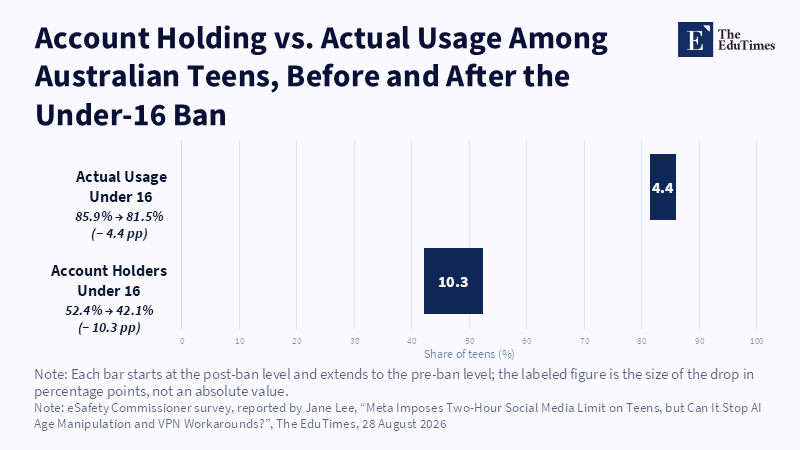
In Australia, where the ban on social media accounts for under-16s has been in place since December 10, 2025, the percentage of minors who had an active account fell from 52.4 percent to 42.1 percent in a matter of months. But the actual usage rate fell by just 4.4 percentage points, from 85.9 percent to 81.5 percent, according to a survey by the eSafety Commissioner. The distance between these two numbers reveals something that any rule based on minutes and hours must eventually address. Teenagers don’t stop using a platform because a rule prohibits it. They just find a way to stay on it. The two-hour limit imposed by Meta on its teenage users after settling $18 billion with 48 U.S. states is set to be tested on exactly this bypass dynamic.
What Meta's Two-Hour Limit Requires
The settlement announced by Meta at the end of August 2026, as recorded by journalist Jane Lee in EduTimes, limits the use of the platform by users under the age of 18 to two hours a day, with a complete blocking of access from midnight to six in the morning. During school hours, from eight in the morning to three in the afternoon, all notifications except private messages are disabled. Teenagers can choose a chronological feed of content instead of an algorithmic one; the number of reactions to posts is hidden and their accounts remain private by default. Lifting any restriction requires explicit parental approval.
The settlement structure also includes a clause that concerns competition between platforms. If YouTube, TikTok and Snap accept similar restrictions, the daily limit for Meta will be reduced to one hour and the night ban will be extended from ten in the evening to seven in the morning. The settlement therefore did not result from a single scientific assessment of how much screen time is safe, but from negotiation between state lawyers and legal advisors of a company, with the limit itself changing depending on the behavior of third parties who were not even involved in the trial.
Borrowed Accounts and Multiple Profiles
The rule measures time per account, not per person. A teenager who creates a second or third profile adds up more hours of access, while an account registered as a person over twenty, belonging to an older sibling, cousin, or acquaintance, removes the time limit entirely. The issue is not theoretical. Research by Newcastle University found that 15 percent of 12- and 13-year-olds and 19 percent of 14- and 15-year-olds in Australia were already using fake accounts to circumvent the account ban, while around 3 percent resorted to virtual private networks to hide their geographical location.
Age verification technology does not seem capable of closing this gap. Testing of eight age estimation models on digitally modified faces with beards, gray hair, makeup and wrinkles found that up to 83 percent of images originally classified as minors were reclassified as adults, according to a February 2026 pre-publication. An Australian government report that tested around 60 age verification technologies from 48 companies acknowledged their practical usefulness but pointed to risks of misclassification around the age of 16 and long-term personal data retention issues. The more sophisticated recognition tools become, the more sophisticated their bypass tools become, particularly when generative AI can produce realistically modified facial images with minimal effort and zero cost.
The Arbitrariness of the Hour
No evidence explains why the correct limit is two hours and not one or three. The settlement’s own competition clause, which lowers the limit to one hour if other platforms participate, reveals that the number is negotiable and not based on a specific safety threshold. A study by the United States National Academy of Sciences, Engineering and Medicine concluded that the existing evidence is insufficient to prove that social media causes population-wide changes in adolescent health, while acknowledging that it provides some adolescents with a channel of communication and support, especially those facing illness, bereavement, or isolation.
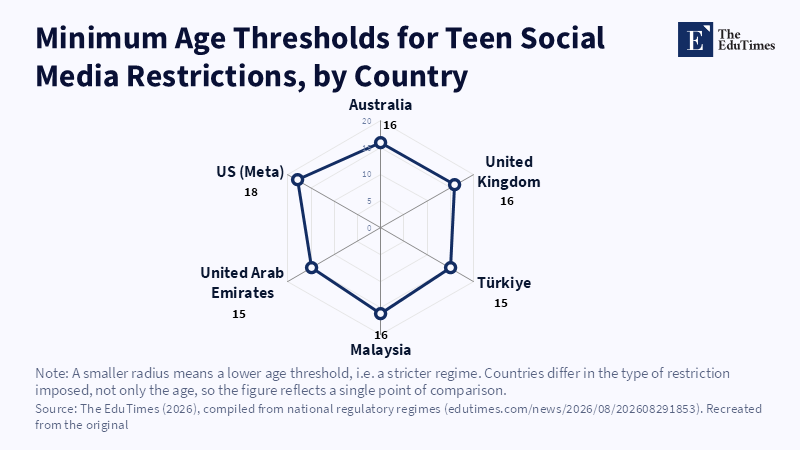
The absence of consensus is not limited to the United States. Australia has opted for a complete ban on accounts under the age of 16. The United Kingdom is preparing to ban the provision of social media services to those under 16, while imposing night limits and disabling content scrolling by default for users aged 16 and 17. Turkey banned social media use for those under 15 in April, Malaysia blocked new registrations under 16 in June, while the United Arab Emirates set a minimum age of 15. This inconsistency is reminiscent of similar contradictions in broader education policy around new technologies, where universities continue to ban artificial intelligence tools while these are already integrated into students’ everyday devices. Each country and each institution ends up with a different number, which shows that the limit reflects political negotiation rather than scientific certainty.
Who Decides for Children
Meta’s settlement explicitly stipulates that restrictions are lifted only with parental approval, which theoretically leaves the final decision to the family. In practice, however, the default has already been set by a company and a team of attorneys general, not by the parents themselves. One could argue that parents have already had the opportunity to self-regulate their children’s use and rarely did, as the Korean online game selection system of the previous decade showed, where the usage rate ranged between 1 percent and 28 percent in a sample of 40 games from seven companies. But this argument overlooks the real reason for low usage. The Korean system required a separate license application for each game, a process with such a high administrative cost that few parents carried it out, not because they were not interested in supervising their children.
An analysis of screen restrictions in schools offers a complementary perspective on the same issue. Uniform rules that apply equally to all students produce unequal results in practice, depending on who has access to alternative devices, who benefits from exceptions for assistive technology and who is enforced more strictly due to the discretion of the adults around them. Ten minutes of passive browsing does not have the same pedagogical value as ten minutes of use for research, accessibility, or creative production, but a limit based solely on minutes cannot make this distinction. The rising cost of laptops due to memory demand for artificial intelligence is already exacerbating inequalities in access to education, reminding us that each technological limitation has a different impact depending on each family’s resources.
The Future of Work That the Rule Ignores
Many of today’s teens will be working in the future in professions that require comfortable, daily familiarity with social media, from content marketing to community management around a brand. EduTimes has already documented how AI is reshaping the path to professions that were once considered guaranteed tickets to high incomes, showing how quickly the skills the job market demands today are changing. A daily two-hour limit, which measures every kind of use in the same way, doesn’t leave much room for structured practice in content creation, audience analysis, or campaign management, activities that typically require more and more flexible time than a fixed cap allows.
The very media coverage of educational technology shows that not every screen hour has the same value. Research presented by Scientific American found that tools that require simple skill repetition offer little learning, while interactive and creatively engaging platforms that provide real-time feedback show real benefits. An arrangement that treats all social media use as an equivalent risk, without distinguishing between passive consumption and active, career-oriented practice, risks limiting exactly the activity that could benefit some teens the most as they approach entering the labor market.
The distance between 52.4 percent and 42.1 percent, on the one hand and 85.9 percent and 81.5 percent, on the other, is not just a statistical margin. It shows where demand is really headed when a rule counts accounts instead of people. Meta’s two-hour limit adopts the same measurement logic at a time when artificial intelligence has already proven that it can bypass age verification in 83% of cases in one test, while internationally there is not even agreement on what age or what hour limit is the right one. Teenagers who create a second account, borrow an older relative’s profile, or find some other technical loophole will not do anything unprecedented. They will simply repeat a pattern that every minute-based setting has already seen, in another country and with another technology.
This article reflects the analytical judgment of The EduTimes Editorial Board and does not constitute policy advice or the official position of any affiliated institution.
References
Im, E. (2021) Korea to Ax Games Curfew. The Korea Herald, 25 August.
Lee, J. (2026) Meta Imposes Two-Hour Social Media Limit on Teens, but Can It Stop AI Age Manipulation and VPN Workarounds? The EduTimes, 28 August.
Parshall, A. (2026) The Backlash Against Screens in Schools Is Escalating. Scientific American, 31 August.
Stewart, A. (2026) The Equity Blind Spot in School Screen-Time Policies. Brookings, 3 September.